Power Up - Upskill Yourself...
❌

Reading view

What Is Relationship Mapping in Dynamics 365 CRM? 10 FAQs on CRM Data Visualization
Sales teams working in Dynamics 365 CRM often struggle to understand complex stakeholder relationships inside large accounts. Relationship mapping in Dynamics 365 CRM is a visual way to understand how accounts, contacts, stakeholders, and opportunities are connected. By transforming CRM records into visual diagrams, teams can identify decision makers, influence paths, and organizational structures more easily.

In this guide, we answer 10 common questions about relationship mapping and CRM data visualization in Dynamics 365 CRM.

What is relationship mapping in Dynamics 365 CRM, and how to implement it?

Relationship mapping in Dynamics 365 CRM is a visual way to understand how accounts, contacts, stakeholders, and opportunities are connected. Instead of analyzing raw records or lists, CRM users can see relationships through visual diagrams, helping them identify key decision makers, influence paths, and hidden connections that affect sales outcomes.

Relationship mapping helps CRM teams:

  • Visualize connections between accounts, contacts, and opportunities
  • Identify decision makers and influencers
  • Understand organizational hierarchies
  • Discover hidden relationships that affect deals

Modern relationship mapping tools like mind maps using Map My Relationship, hierarchy views, and influence maps make relationship mapping easier by transforming complex CRM data into clear visual networks.

How does relationship mapping help close deals in Dynamics 365 CRM?

Relationship mapping helps close deals faster by identifying the right people to engage within a customer organization. By visualizing decision makers, influencers, and reporting structures, sales teams can prioritize key contacts and build stronger engagement strategies that accelerate deal progression.

Relationship mapping enables sales teams to:

  • Identify decision makers vs influencers
  • Understand reporting structures
  • Track existing relationships across accounts
  • Plan multi-threaded sales strategies

Visual CRM tools like Map My Relationship allow teams to see who knows whom, which improves outreach and stakeholder engagement.

How can you visualize relationships between accounts and contacts in Dynamics 365?

You can visualize relationships between accounts and contacts in Dynamics 365 by using CRM visualization tools that convert relational data into visual diagrams such as mind maps, hierarchy trees, or organizational charts. These views make it easier to understand how stakeholders are connected across accounts and opportunities.

Typical CRM visualization methods include:

  • Mind Map View – displays connections between contacts and stakeholders
  • Hierarchy View – shows account structures
  • Tree View – visualizes parent-child relationships
  • Influence Mapping – identifies key decision makers

Solutions like relationship mapping apps for Dynamics 365 enable these visualizations directly inside the CRM interface.

 What is influence mapping in CRM relationship management?

Influence mapping is a CRM technique used to identify the people who influence purchasing decisions within an organization. Instead of focusing only on primary contacts, influence maps visualize connections between stakeholders, helping sales teams understand internal dynamics and build stronger relationship strategies.

Influence mapping helps teams:

  • Identify champions and blockers
  • Understand internal stakeholder influence
  • Plan targeted engagement strategies
  • Navigate complex enterprise accounts

Advanced CRM visualization tools like Map My Relationship represent influence relationships using interactive relationship maps

What are the best ways to visualize complex CRM relationships?

The best ways to visualize complex CRM relationships include using mind maps, hierarchy charts, tree views, and network diagrams. These visualization methods transform CRM records into structured visual models that help users understand connections, organizational structures, and influence paths quickly.

Popular CRM visualization approaches include:

Visualization Type  Purpose
Mind Map Shows relationship networks
Hierarchy Chart Displays organizational structure
Tree View Maps parent-child relationships
Influence Map Shows decision-making power

Modern Dynamics 365 tools like Map My Relationship integrate these views directly within CRM dashboards.

What Is Relationship Mapping in Dynamics 365 CRM? 10 FAQs on CRM Data VisualizationCan Dynamics 365 CRM show account hierarchies visually?

Yes, Dynamics 365 CRM can display account hierarchies visually using hierarchy charts and relationship visualization tools. These visual structures help CRM users understand parent companies, subsidiaries, and business unit relationships within large organizations.

Account hierarchy visualization helps with:

  • Enterprise account management
  • Understanding corporate structures
  • Planning account-based sales strategies
  • Managing multi-location customers

Advanced CRM apps like Map My Relationship enhance these capabilities by providing interactive hierarchy views and relationship diagrams.

What is the best tool for relationship mapping in Dynamics 365 CRM?

The best relationship mapping tools for Dynamics 365 CRM allow users to visualize complex relationships through multiple interactive views such as mind maps, tree diagrams, and influence maps. These tools help sales and relationship managers understand stakeholder networks and account structures without leaving the CRM environment.

An effective relationship mapping solution should provide:

  • Mind Map relationship visualization
  • Account hierarchy charts
  • Influence mapping
  • Tree and network views
  • Interactive CRM relationship diagrams

Solutions like Map My Relationships transform Dynamics 365 data into visual relationship intelligence, making it easier for teams to analyze connections and manage complex accounts.

What is stakeholder mapping in CRM?

Stakeholder mapping in CRM is the process of identifying and visualizing individuals who influence purchasing decisions within an organization. By mapping stakeholders, sales teams can understand relationships between decision makers, influencers, and internal champions.

Stakeholder mapping helps with:

  • Enterprise deal management
  • Account-based selling strategies
  • Influence identification
  • Strategic relationship planning

Visualization tools often represent stakeholders through interactive relationship diagrams.

What is influence mapping in Dynamics 365 Sales?

Influence mapping is a technique used to identify how different stakeholders affect purchasing decisions within an organization. Instead of focusing only on primary contacts, influence maps show how decision makers, influencers, and internal champions are connected.

Influence mapping helps sales teams:

  • Understand internal power dynamics
  • Identify champions and blockers
  • Plan targeted engagement strategies
  • Navigate complex enterprise sales cycles

CRM visualization tools often represent influence relationships using interactive maps.

What Is Account Relationship Mapping in CRM?

Account relationship mapping in CRM is the process of visually representing how contacts, departments, subsidiaries, and partner organizations are connected to a customer account. Instead of viewing isolated records, relationship maps display these connections in a structured visual format, helping sales teams understand influence networks, organizational structures, and key stakeholders.

Account relationship mapping typically includes:

  • Mapping internal contacts: Identifying how decision makers, influencers, and end users are connected within an organization.
  • Mapping partner relationships: Understanding connections between customers, vendors, resellers, or strategic partners involved in the business ecosystem.
  • Mapping subsidiaries and parent companies: Visualizing corporate structures such as holding companies, regional branches, and business units.
  • Tracking cross-account connections: Discovering relationships between contacts who interact with multiple accounts, departments, or opportunities.

These relationships are often visualized using relationship network diagrams, org charts, hierarchy charts, or stakeholder maps, allowing CRM users to quickly interpret complex account structures and engagement pathways. Tools designed for CRM relationship visualization can transform standard CRM records into interactive relationship maps, making it easier to analyze stakeholder influence and manage complex enterprise accounts.

Relationship mapping transforms traditional CRM records into visual relationship intelligence. By combining stakeholder mapping, influence visualization, and account hierarchy views, sales teams gain a clearer understanding of complex customer ecosystems inside Dynamics 365.

Get a 15-day free trial from Inogic Website or Microsoft Marketplace. If you want an end to end implementation demo, reach out to us at crm@inogic.com.

The post What Is Relationship Mapping in Dynamics 365 CRM? 10 FAQs on CRM Data Visualization first appeared on Microsoft Dynamics 365 CRM Tips and Tricks.
How to Use JSON Output in AI Builder Prompts for Structured Automation

JSON Output If you’ve been working with AI in your business processes lately, you’ve probably run into a really frustrating roadblock: the gap between the chatty text an AI wants to give you and the structured data your automation actually needs.
Let’s say you’re building a Power Automate flow to pull details out of customer emails. You want the person’s name, the priority, and the category. Ideally, you want to get back something clean like this:

JSON:

{

"customer_name": "Sarah Johnson",

"priority": "High",

"issue_category": "Billing"

}

Instead, the AI usually gives out a whole paragraph:

“The customer, Sarah Johnson, appears to have a high-priority concern related to billing. It would be advisable to route this to the finance team for further assistance.”

That’s great if a human is reading it. But for an automated flow? It’s a nightmare. You end up trying to write expressions using ‘split()’ or regular expressions just to grab the values you want, and if the AI rephrases even slightly on the next run, those expressions break. The core issue is straightforward: AI produces conversational text, but automated systems require structured, predictable data.

Microsoft’s Power Platform has a fix for this inside the AI Builder Prompt action. Whether you are using Power Automate or Copilot Studio, you can just tell the AI to hand you back perfectly formatted JSON instead of a paragraph. And the best part? That JSON maps straight into your Dynamics 365 fields, your flow conditions, or your Copilot variables. No messy parsing needed.

Understanding AI Builder Prompts

The Prompt tool can be accessed via the Power Apps maker portal, under AI Builder in Prompts. It allows users to define a custom AI instruction with optional dynamic input variables, and the generated response can be consumed in Power Automate or in Copilot Studio. By default, the output is plain text, but switching the output format to JSON enables the AI to return a structured object that downstream actions consume directly.

As a general guideline: use text output when communicating with a user, and JSON output when communicating with a system.

Setting Up a Prompt with JSON Output:

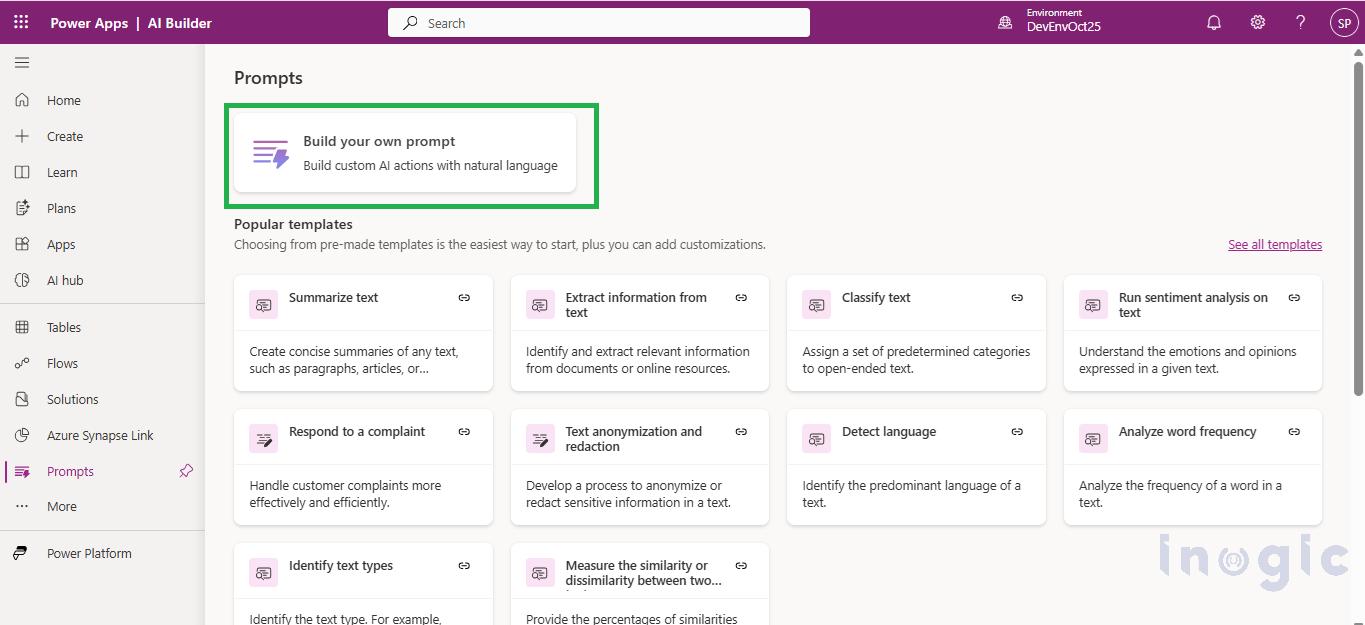
Navigate to Power Apps maker portal, under AI Builder in Prompts select the Build your own Prompt.

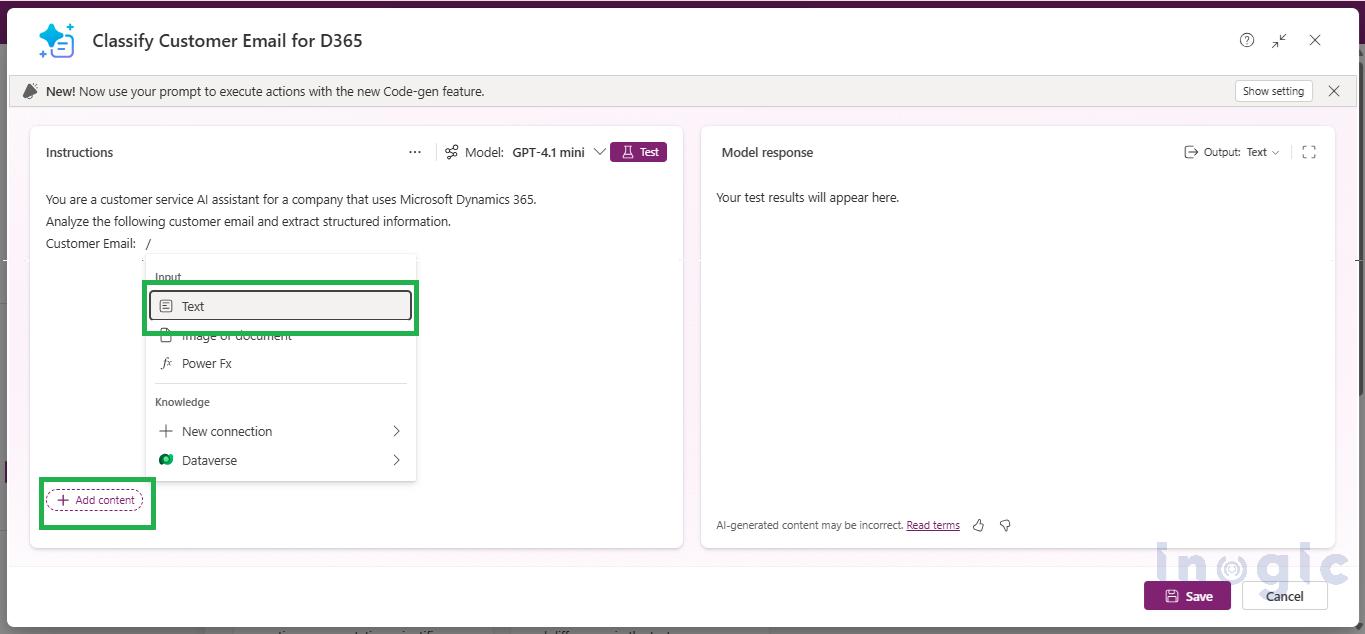
Configuring JSON Output with AI Builder Prompts in Power AppsWhen writing the prompt, three elements are essential: a clear task definition, the JSON schema (field names, data types, allowed values), and explicit output constraints (return only the JSON, no extra text or formatting). Define dynamic inputs by clicking on Input, for example, an ‘EmailBody’ variable to hold customer email text passed from a flow.
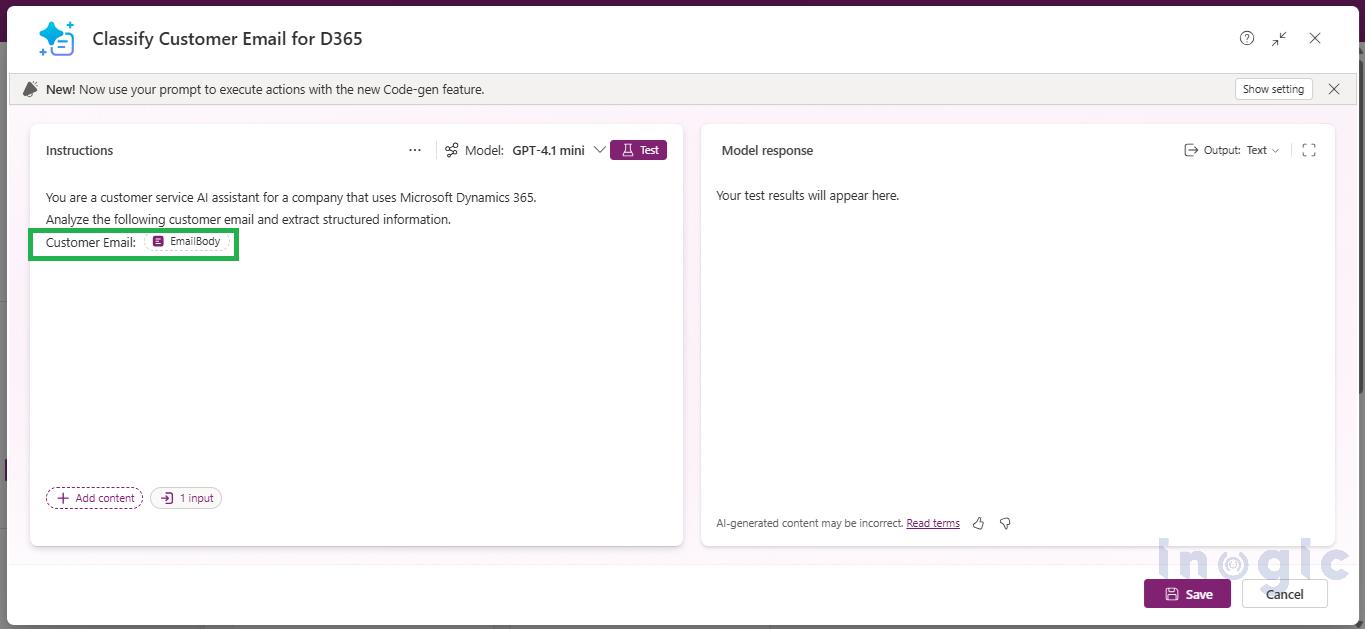
Configuring JSON Output with AI Builder Prompts in Power Apps

Configuring JSON Output with AI Builder Prompts in Power AppsIn the configuration panel, change the Output format from Text to JSON. Use the built-in Test feature to validate the response structure.
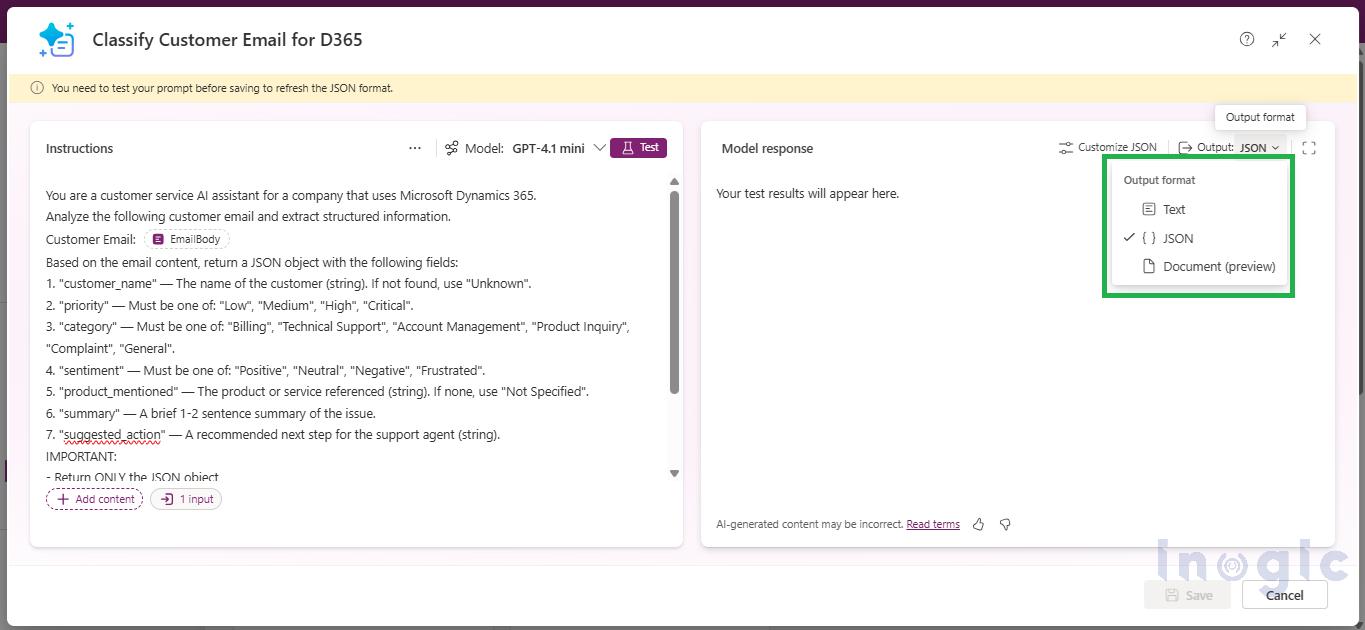
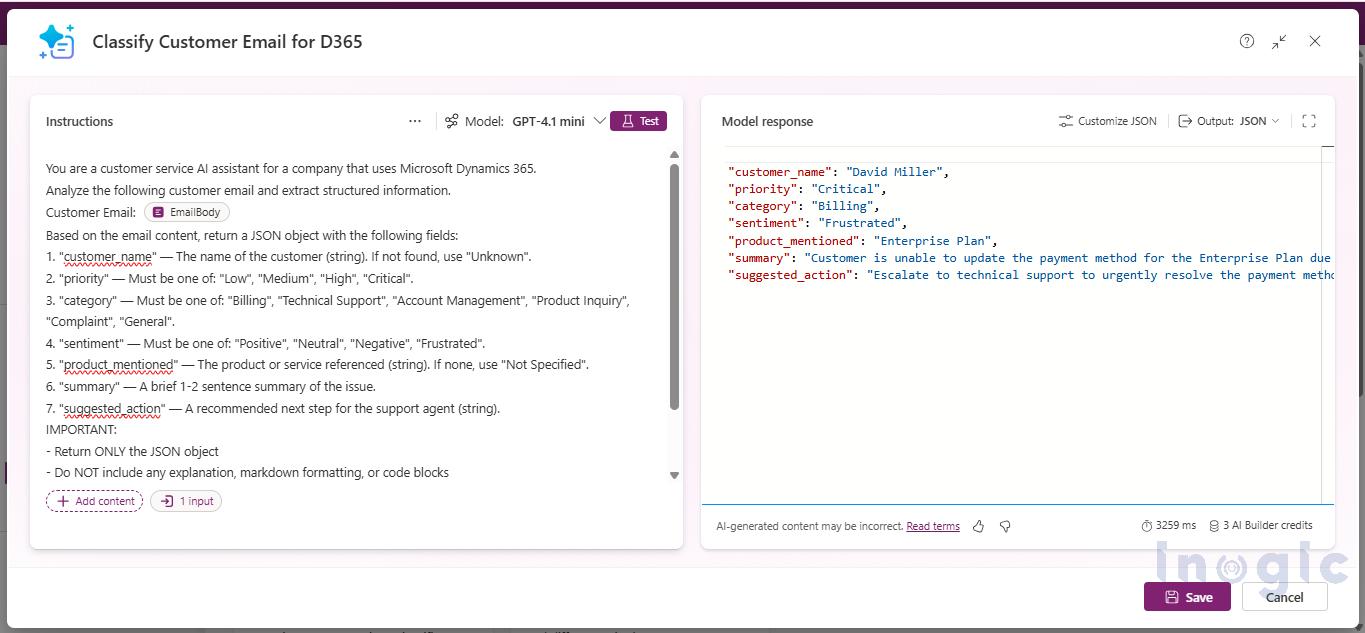
Configuring JSON Output with AI Builder Prompts in Power Apps

Configuring JSON Output with AI Builder Prompts in Power AppsOnce tested, integrate it into Power Automate via the “Run a prompt” action, or into Copilot Studio as a Prompt Tool directly or use it within a topic.
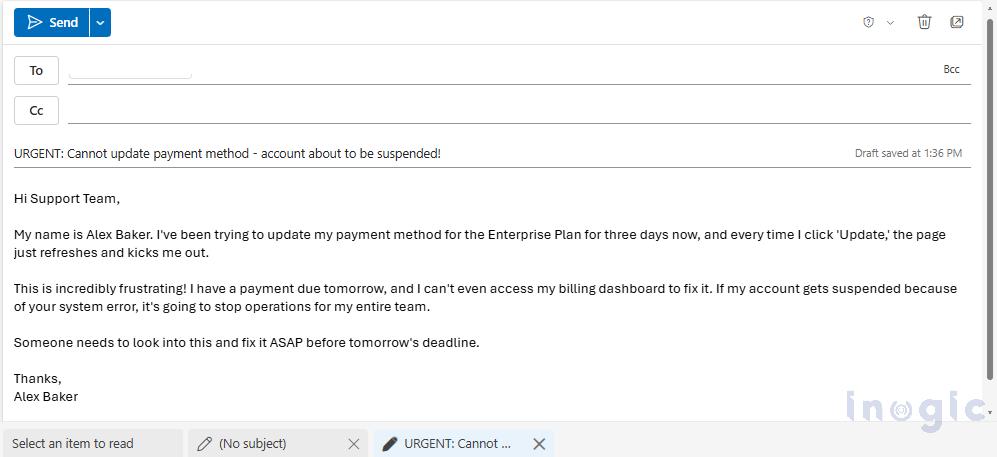
Automated Email Categorization with Power Automate

Support teams get flooded with emails every single day. Usually, a human has to sit there, read each one, figure out the priority, guess the customer’s mood, and write a summary.

By combining the Prompt tool with JSON output, you can put this whole categorization process on autopilot. Here is roughly how it flows:

– An Email Arrives: A distressed customer sends an email regarding a critical payment failure on their account.

Configuring JSON Output with AI Builder Prompts in Power Apps– The Prompt Analyzes: Your flow triggers immediately, grabs that email text, and ships it over to the AI Builder Prompt you built.
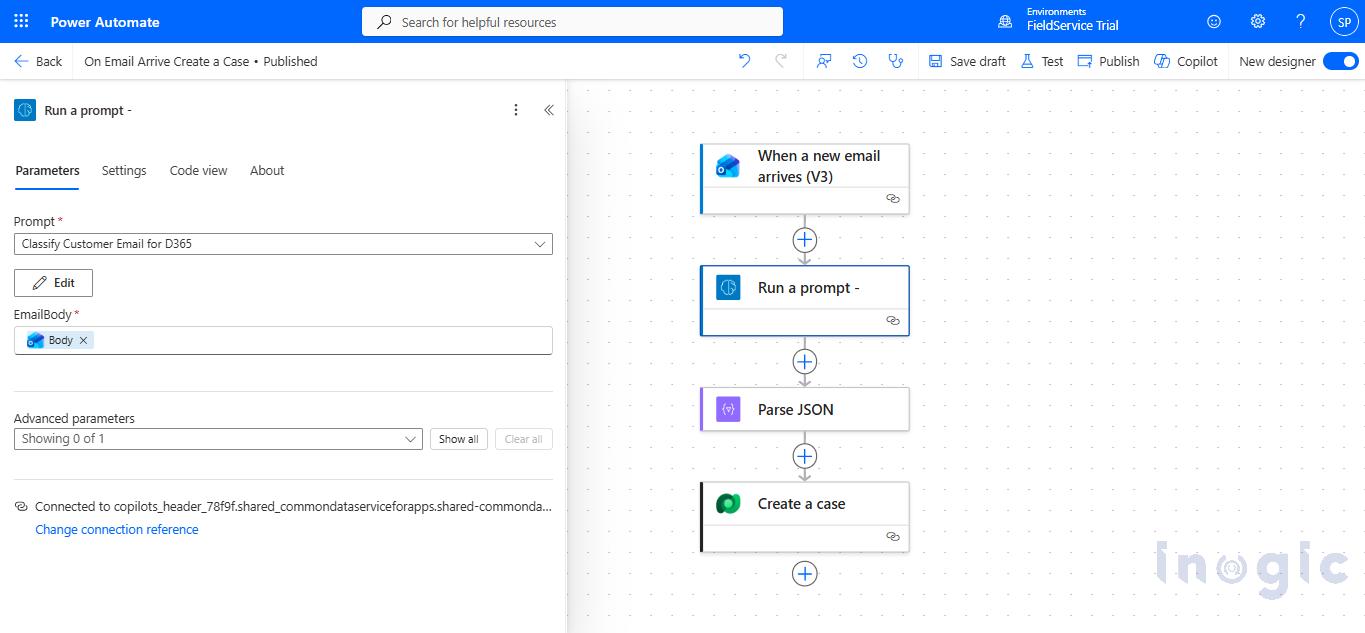
Configuring JSON Output with AI Builder Prompts in Power Apps– Clean Data is Structured: The AI reads it, understands the context, and hands you back a neat JSON block.
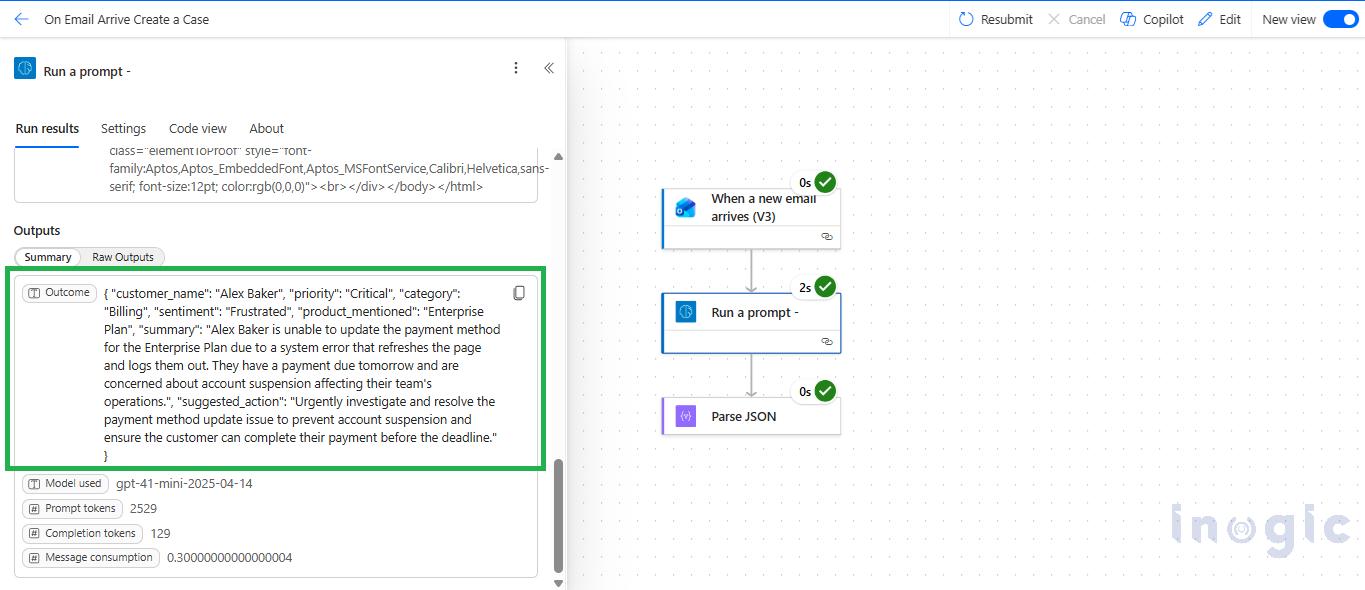
Configuring JSON Output with AI Builder Prompts in Power Apps– Parsed for Automation: Using the “Parse JSON” action in Power Automate, the structured data is instantly converted into dynamic content. You can now use these variables anywhere in your flow to route the email to the right team, trigger an urgent alert, or seamlessly create a record in Dataverse.
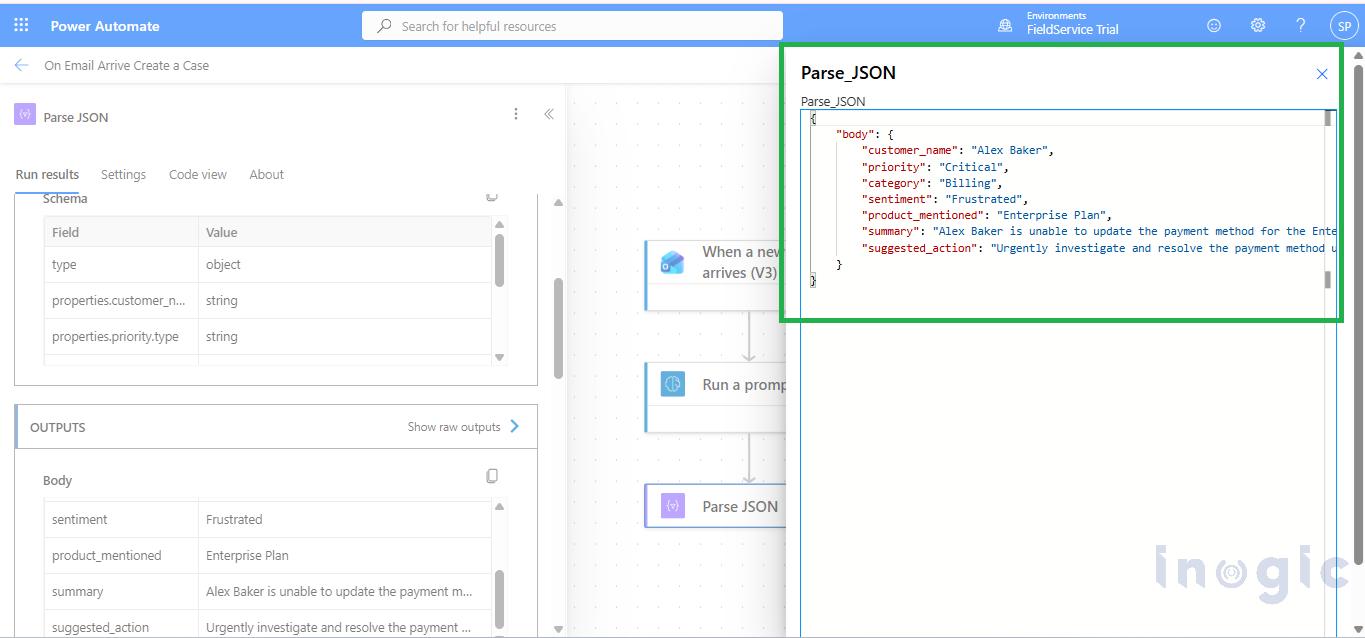
Configuring JSON Output with AI Builder Prompts in Power AppsConclusion

Switching AI Builder Prompts to JSON output is a simple but powerful enhancement for building production-ready automation.

While text responses are useful for human interaction, JSON output provides the structure required for reliable system integration.

This approach:

  • Eliminates fragile parsing logic
  • Ensures consistent AI responses
  • Enables direct mapping to business systems

For any solution involving Power Automate, Copilot Studio, or Dynamics 365, using JSON output is one of the most impactful improvements you can make with minimal effort.

FAQs

What is JSON output in AI Builder Prompts?

JSON output is a structured response format in AI Builder Prompts that returns data as key-value pairs instead of conversational text, making it easier for automation systems to process.

 Can JSON output integrate with Dynamics 365?

Yes, structured JSON fields can map directly into Dynamics 365 entities and records without additional transformation.

 Can JSON output integrate with Dynamics 365?

Yes, structured JSON fields can map directly into Dynamics 365 entities and records without additional transformation.

What problems does JSON output solve in AI automation?

It eliminates inconsistent AI responses, removes the need for regex or string parsing, and ensures stable automation workflows.

How do I enable JSON output in Power Apps AI Builder Prompts?

In the Power Apps maker portal, go to AI Builder → Prompts, create or edit a prompt, and change the output format from Text to JSON in the configuration panel.

The post How to Use JSON Output in AI Builder Prompts for Structured Automation first appeared on Microsoft Dynamics 365 CRM Tips and Tricks.

Generating and Sharing Screen in PDFs from D365 Sales Using Canvas Apps

Canvas Apps

In many Dynamics 365 Sales implementations, sales users need a simple and intuitive way to preview a quote, generate a PDF, and share it with customers. Traditionally, this requirement is handled using Word templates, which often feel rigid, require backend configuration, and do not provide a smooth preview experience for users.

Microsoft has introduced PDF generation and PDF preview capabilities in Canvas apps, making it possible to convert Canvas app screens or containers into PDF files and preview them directly within the app. These capabilities open new possibilities for creating user-friendly, preview-first document generation experiences in D365 Sales.

In this blog, we demonstrate how to build a Canvas app that allows users to view quotes, preview quote details as a PDF, and prepare the PDF for sharing, all using native Power Apps functionality.

How This Works (High-Level Overview)

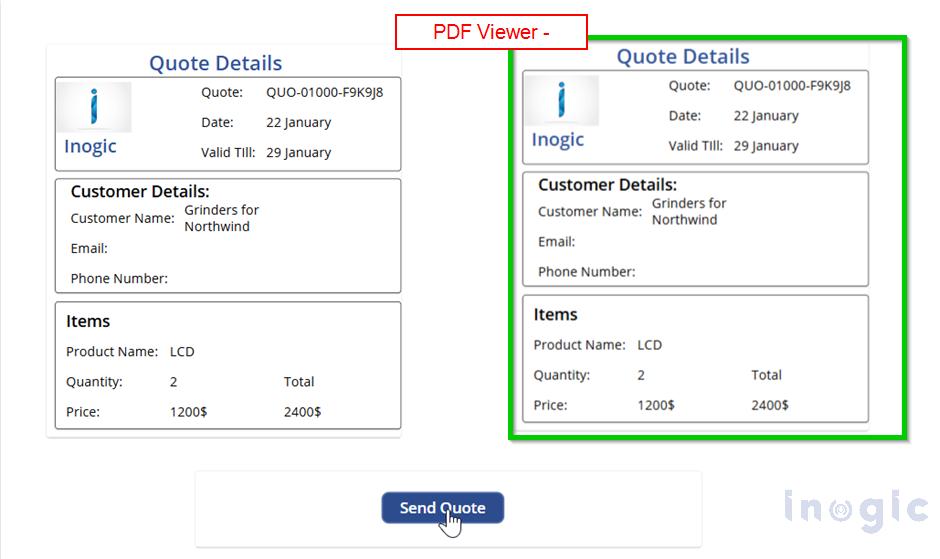
This approach uses a Canvas app embedded in D365 Sales to display quote data. A specific container holding the quote layout is converted into a PDF using the PDF() function. The generated PDF is stored in a variable and passed to the PDF Viewer control, allowing users to preview the document before sharing or processing it further.

App Design Overview

To keep the user experience simple and intuitive, the app is designed with two screens.

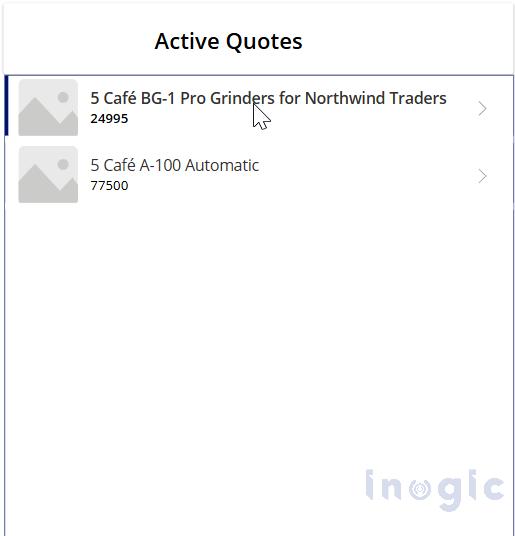
Screen 1: Active Quotes

The first screen displays active quotes in a gallery, as shown below.

This screen acts as the entry point for the user and allows quick selection of a quote.

When a user selects a quote:

  • The selected quote is stored in a variable
  • The app navigates to the quote preview screen

Generating and Sharing Screen in PDFs

This approach keeps quote selection fast and avoids unnecessary navigation between screens.

Screen 2: Quote Details and Quote Preview

The second screen is designed to display quote details and a PDF preview side by side.

On this screen, I have used two containers:

  • One container to display the quote details
  • Another container to preview how the quote will appear in the PDF Viewer

To display the PDF in the PDF Viewer, the following approach is used:

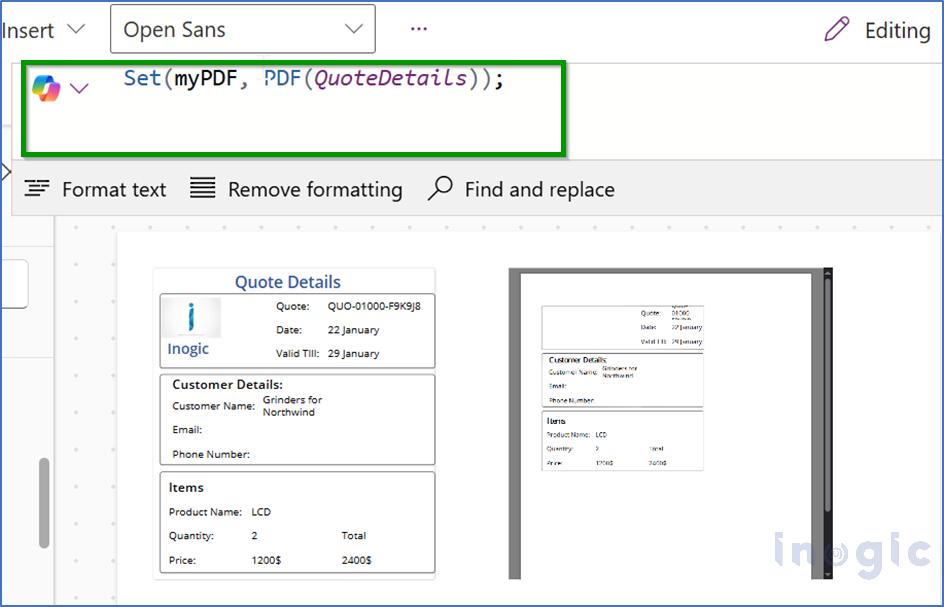
Generating the PDF

The PDF() function is used to generate a PDF from the quote details container.
The generated PDF is stored in a variable (MyPdf).

Generating and Sharing Screen in PDFs

This ensures that the same layout used to display quote details is reused for PDF generation.

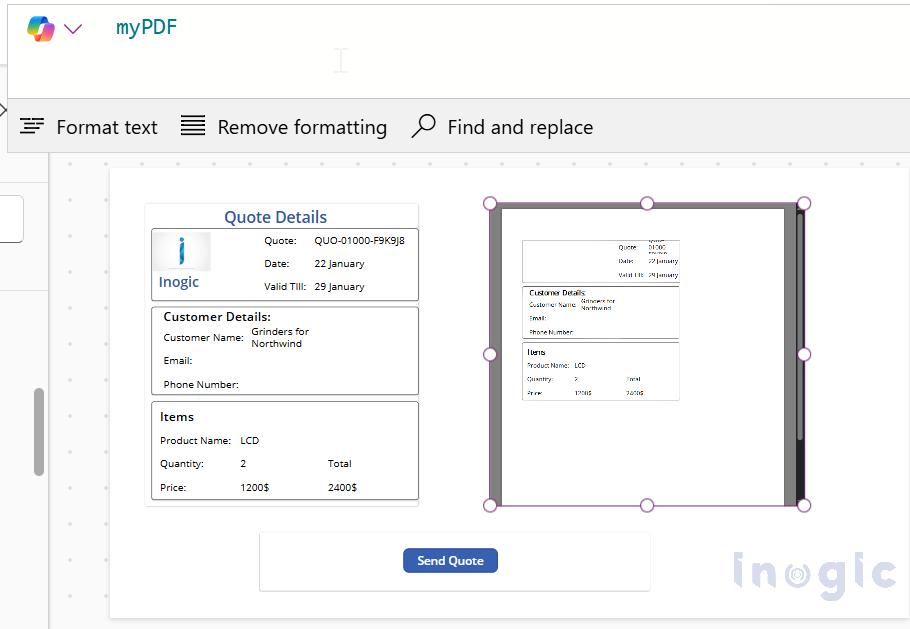
Previewing the PDF

The MyPdf variable is then passed to the PDF Viewer control, allowing users to preview exactly how the PDF will look before it is shared.

Generating and Sharing Screen in PDFs

This provides a true “what you see is what you get” experience for the user.

Below is how the page layout looks with the quote details on one side and the PDF preview on the other.

Generating and Sharing Screen in PDFs


Generating and Sharing Screen in PDFs

Important Note on Experimental Features

At the time of writing, both the PDF () function and the PDF Viewer control are marked as Experimental features in Power Apps.

Benefits of This Approach

  • Preview-first user experience
  • No dependency on Word templates
  • Flexible and easily customizable layouts
  • Consistent PDF output
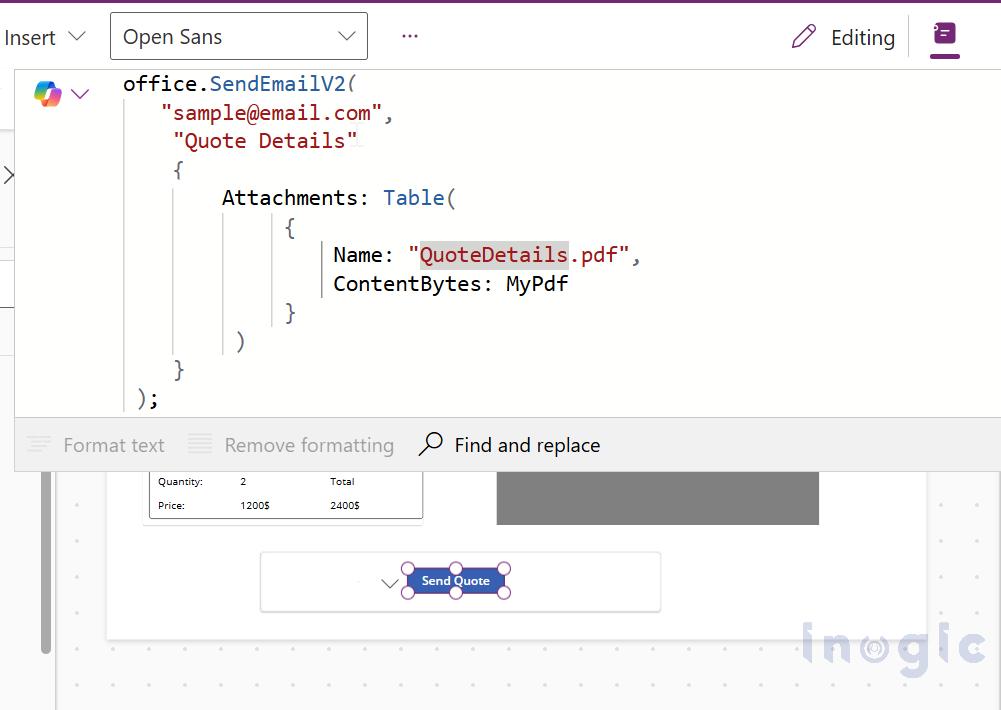
  • Simple integration with Power Automate for further processing

Real-World Use Cases

This pattern can be applied across multiple D365 Sales and business scenarios, including:

  • Quote generation and sharing
  • Invoice previews
  • Order confirmations
  • Service reports
  • Custom sales documents

The same reusable layout approach ensures consistency across documents while keeping the user experience simple.

FAQs

Can Canvas apps generate PDFs in D365 Sales?
Yes. Canvas apps support the PDF() function, which allows screens or containers to be converted into PDF files that can be previewed or shared.

Do I need Word templates to generate PDFs in D365 Sales?
No. This approach removes the dependency on Word templates by generating PDFs directly from Canvas app layouts.

Can users preview PDFs before sharing them?
Yes. The PDF Viewer control allows users to preview the generated PDF inside the Canvas app before sharing.

Can this be integrated with Power Automate?
Yes. The generated PDF can be easily passed to Power Automate for emailing, storage, or further processing.

Conclusion:

By combining Canvas apps with the PDF() function and PDF Viewer control, it is now possible to create lightweight and flexible document generation experiences directly within D365 Sales.

This approach allows users to preview, generate, and share quote PDFs using a single reusable layout, improving usability and reducing dependency on backend templates.

The same pattern can be extended to other scenarios such as invoices, orders, service reports, or any use case where formatted documents are required.

The post Generating and Sharing Screen in PDFs from D365 Sales Using Canvas Apps first appeared on Microsoft Dynamics 365 CRM Tips and Tricks.

How to Customize the Task Pane in Project Operations

Earlier, the Task Details pane in Project Operations was standard and not customizable at admin level. When users clicked the info icon present next to a task, a fixed task pane from Project showed only predefined fields. Organizations could not add custom fields or modify the layout, so users often had to navigate away from the task grid to view or update additional task details.

Now, with the latest update, the task pane is customizable. Using this feature, we can customize tasks of a project within the Task Pane itself. This allows users to view and update all relevant task information directly from the task pane, improving efficiency while still keeping the option to access the original standard view if needed.

In this blog, let us explore how to Customize Task Pane in Project Operations.

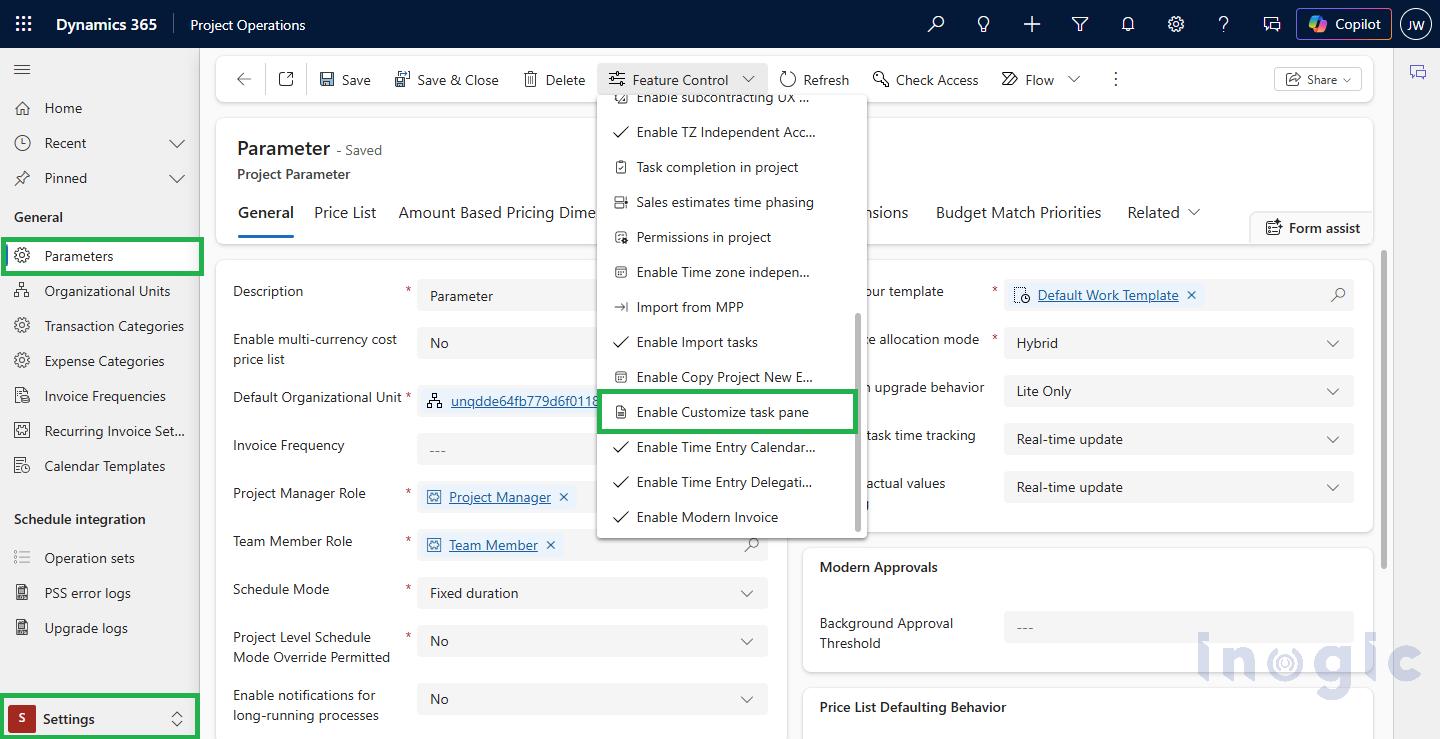
  • To enable theCustomize Task Pane feature in Project Operations, navigate to the Parameters entity present in the Settings
  • Click on the Feature Control button on the ribbon bar, as shown below.

How to Customize the Task Pane in Project Operations

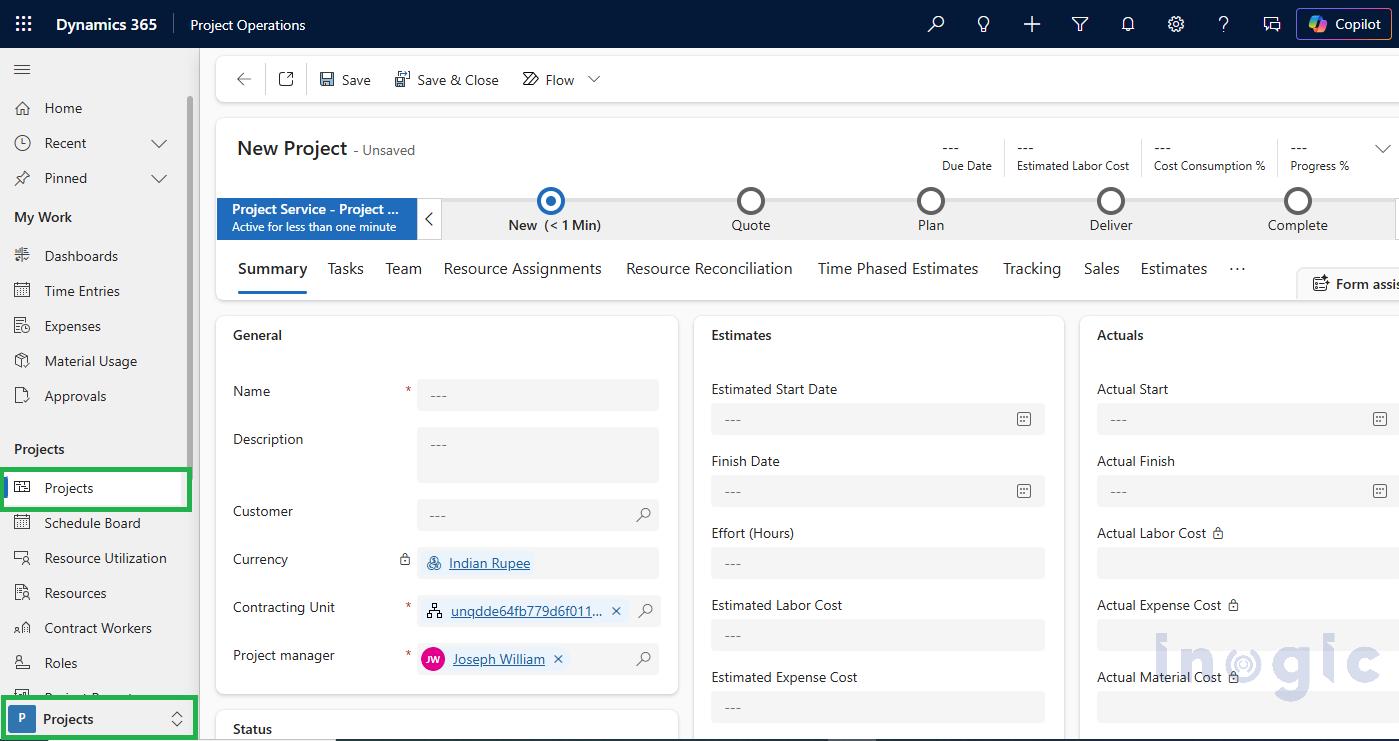
  • After enabling Customize Task Pane feature, navigate to Projects area under Projects group click on Projects

Note: Choose Existing Project or create a New Project.

How to Customize the Task Pane in Project Operations

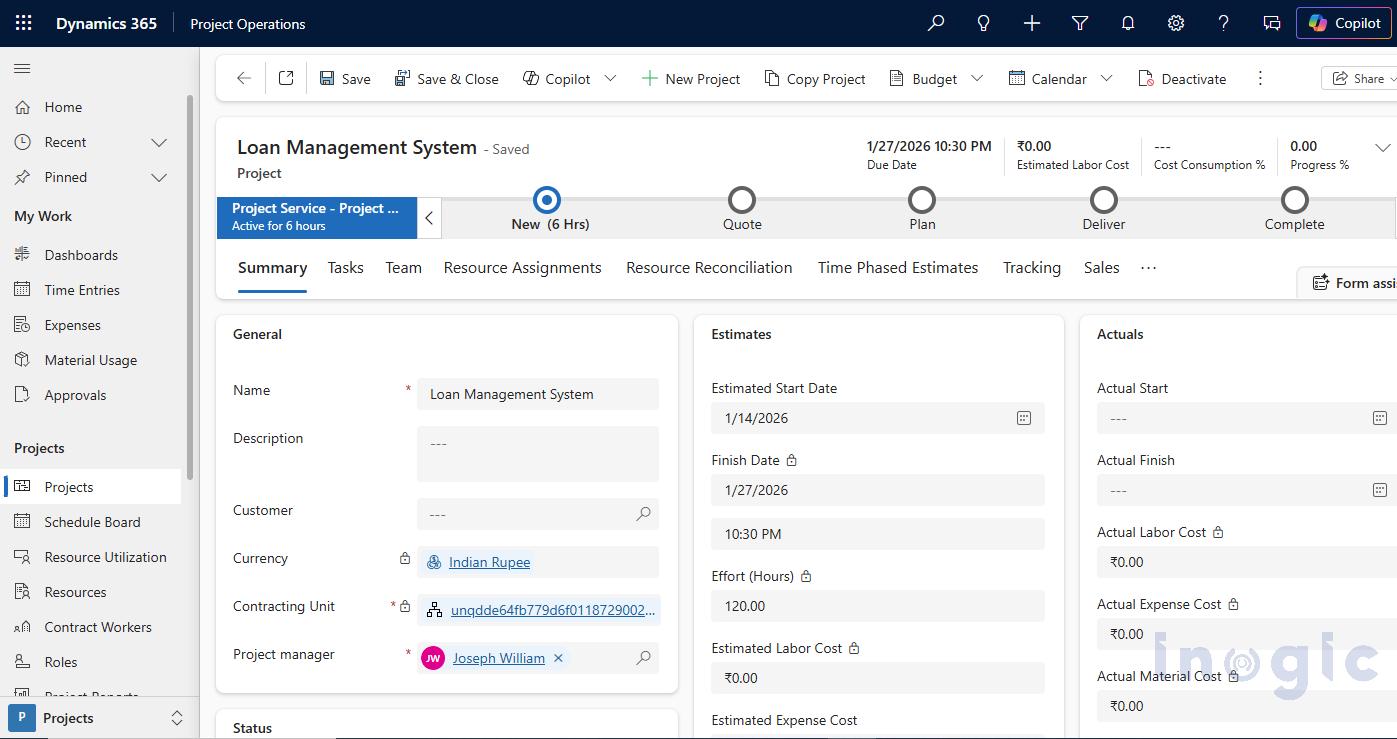
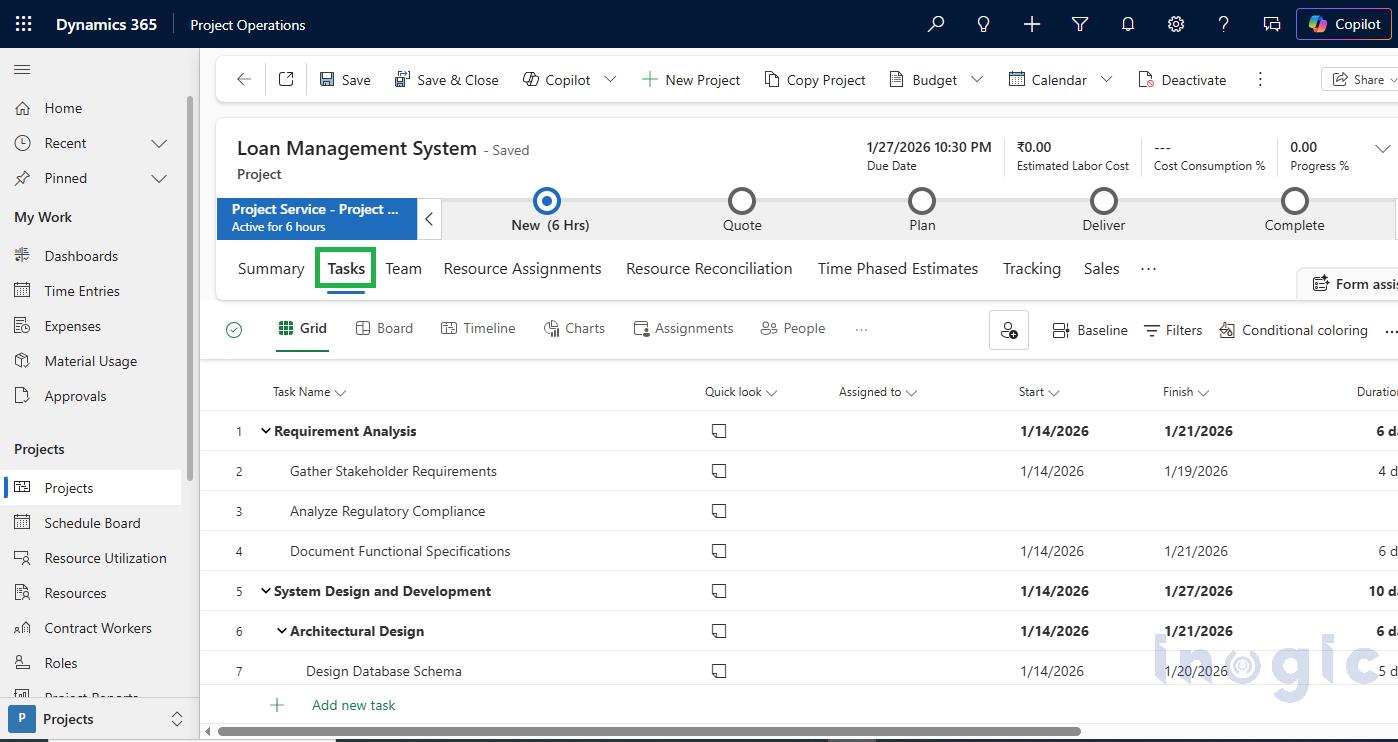
  • Let us create a project with all the required details, save it and then navigate to the Tasks tab

How to Customize the Task Pane in Project Operations

How to Customize the Task Pane in Project Operations

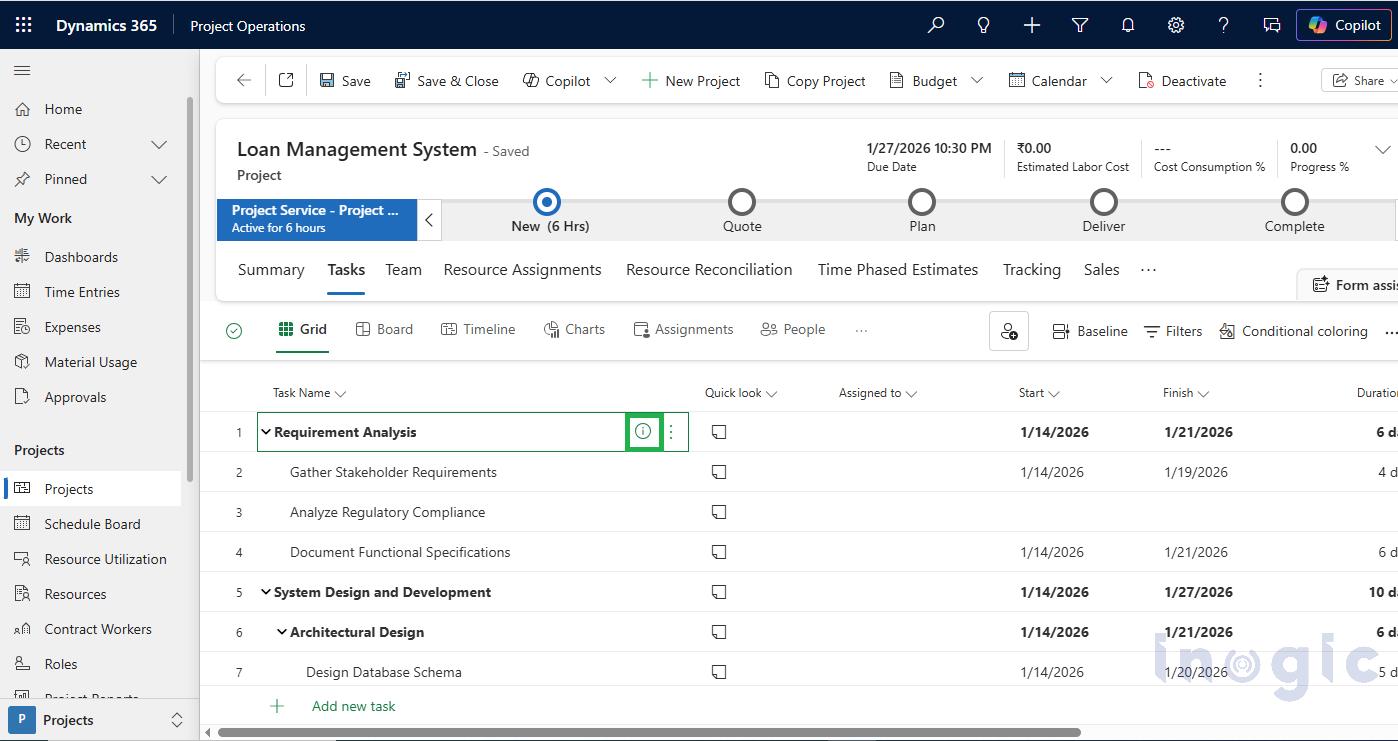
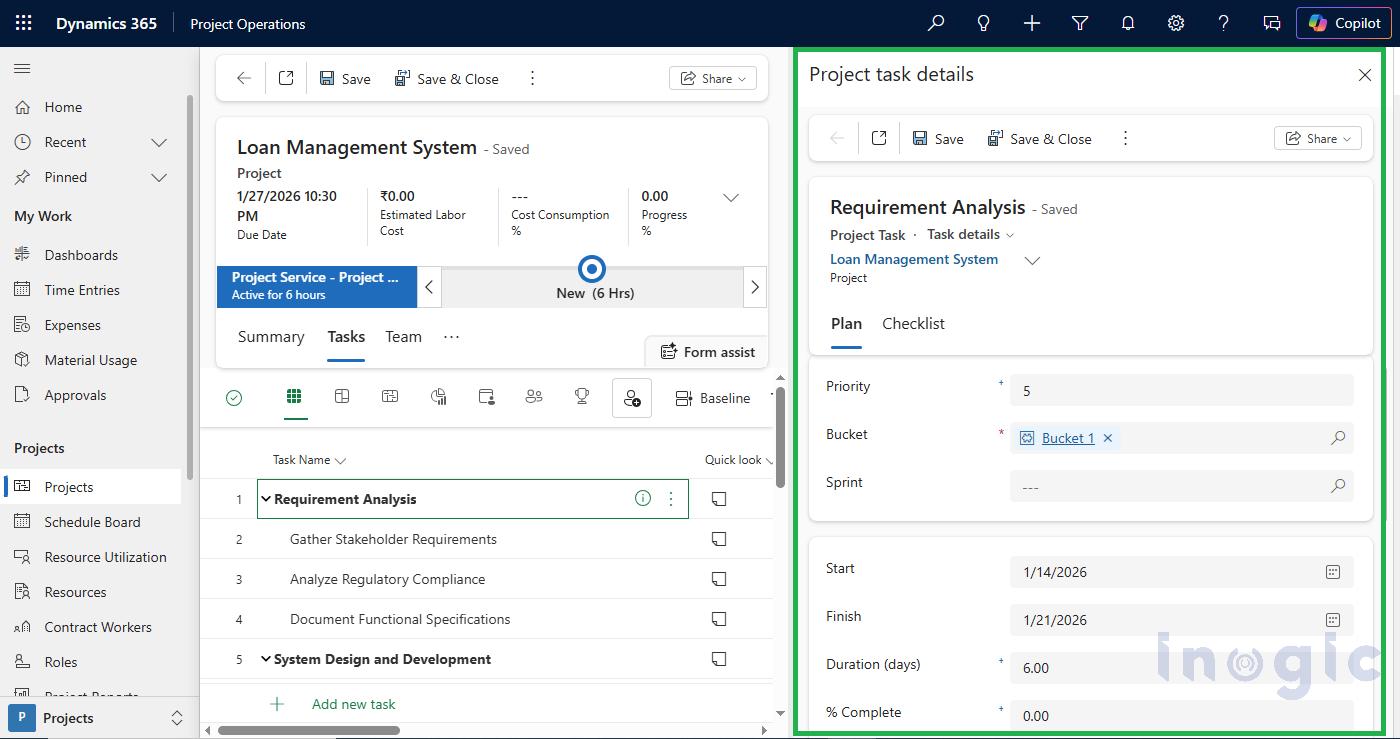
  • Add the tasks required to complete your project. Click on any task’s ⓘ icon to view its details in the new Task Side Pane.

How to Customize the Task Pane in Project Operations

How to Customize the Task Pane in Project Operations

  • Now, let us navigate to Power Apps to customize the Task Side Pane. This customization allows users to view and update task details directly from the Task Grid, eliminating the need to open separate pages or navigate away from their current screen.
  • As a result, users can manage tasks more efficiently within a single, streamlined interface.

 Steps to customize the Task Pane:

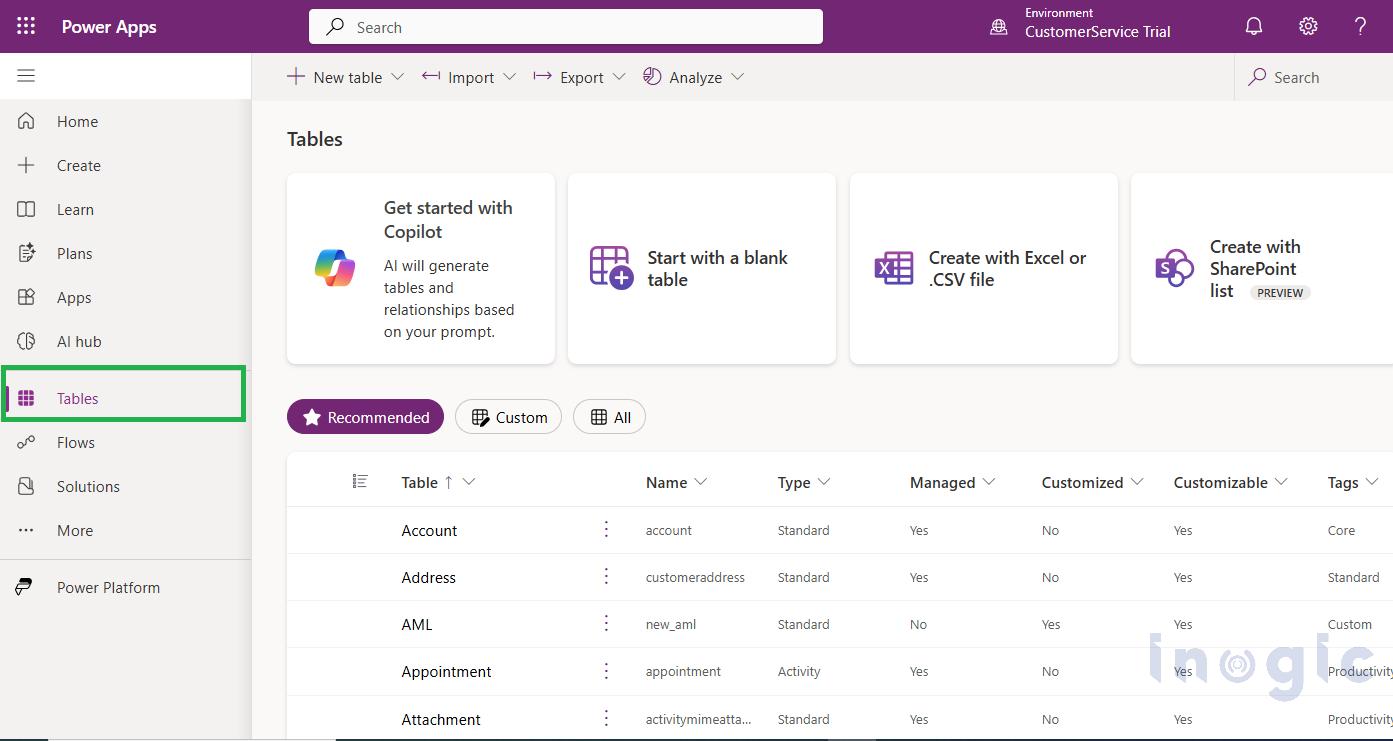
1. Navigate to Power Apps and click on Tables as below –

How to Customize the Task Pane in Project Operations

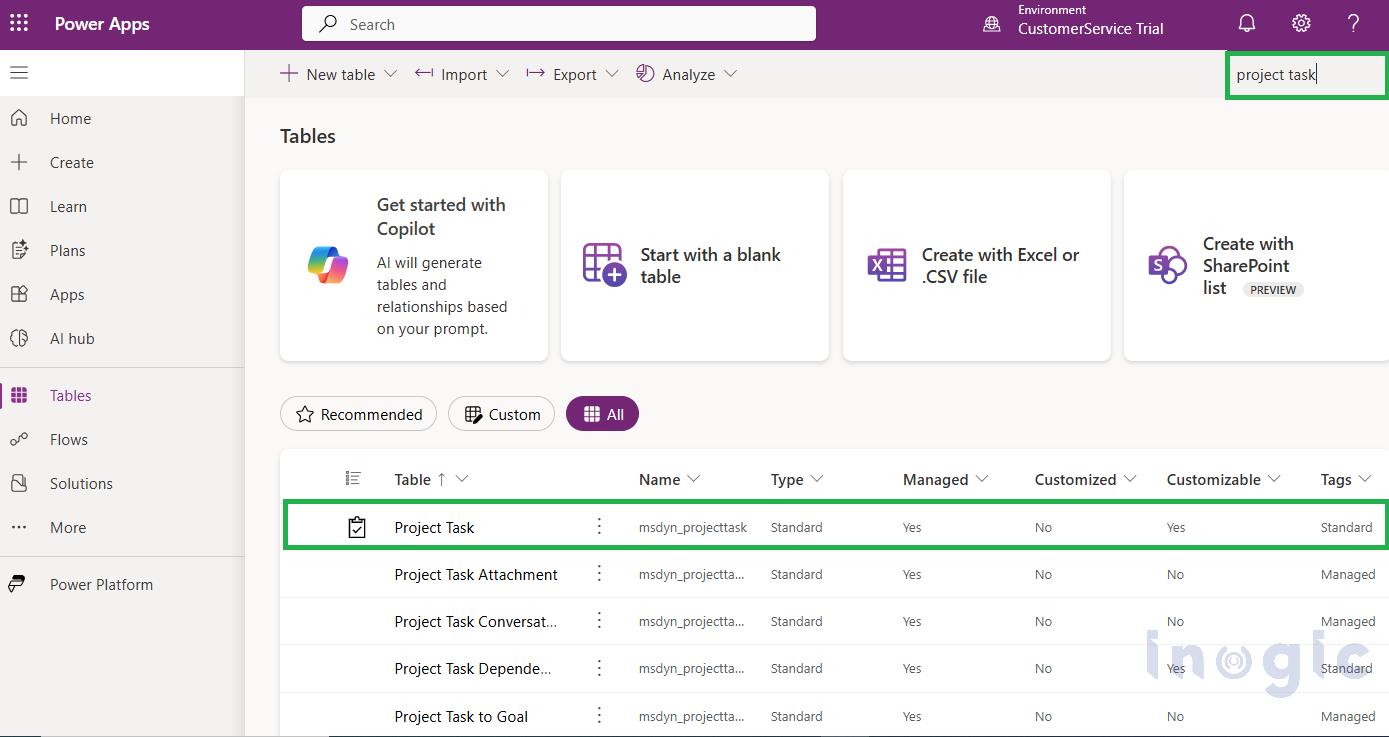
2. Search Project Task form and click on it.

How to Customize the Task Pane in Project Operations

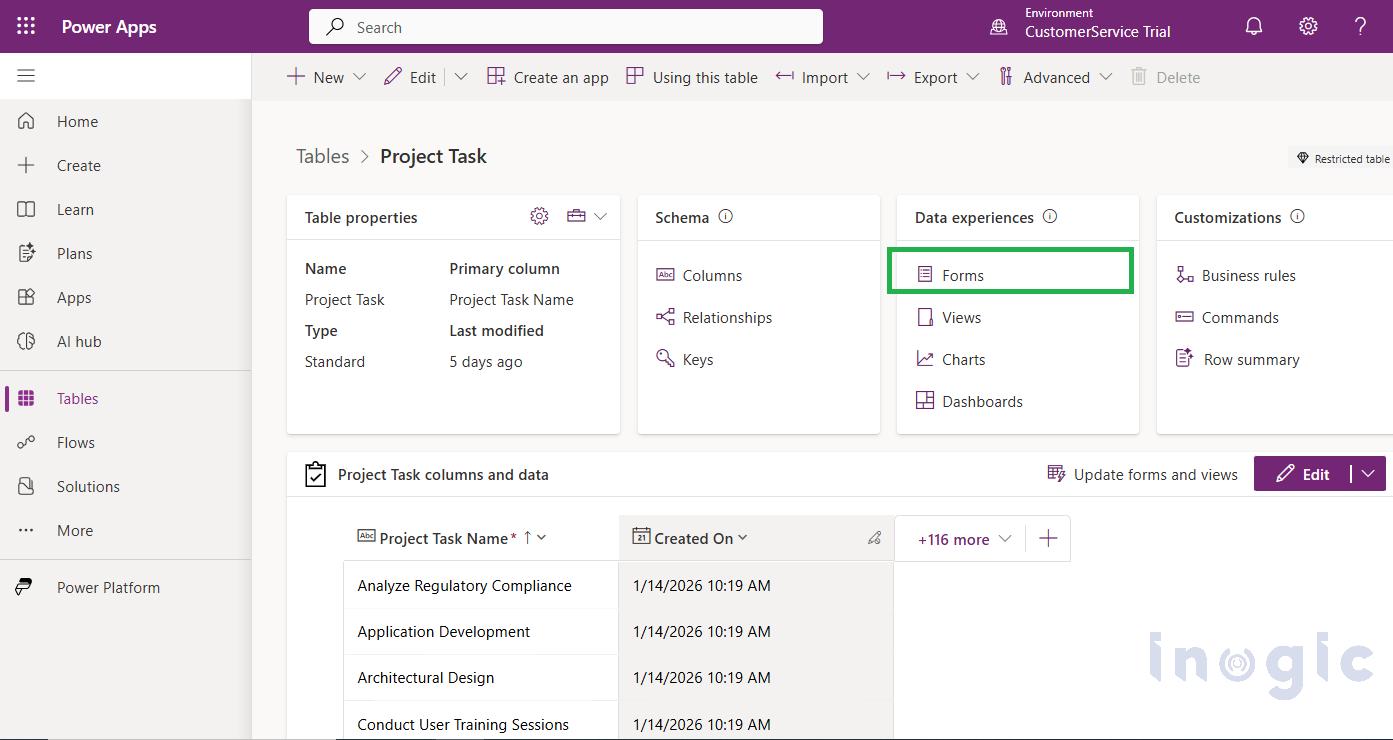
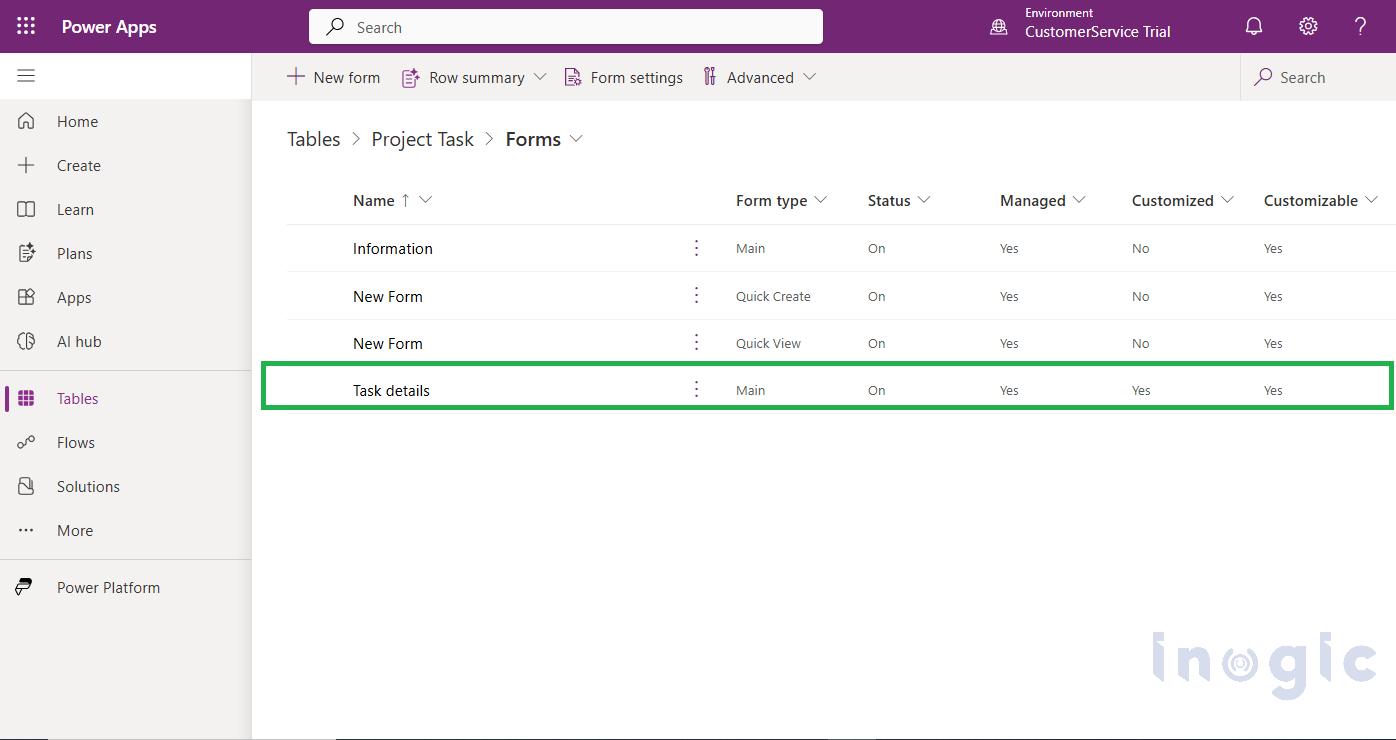
3. In Data experiences select Forms & click on Task details

How to Customize the Task Pane in Project Operations

How to Customize the Task Pane in Project Operations

How to Customize the Task Pane in Project Operations

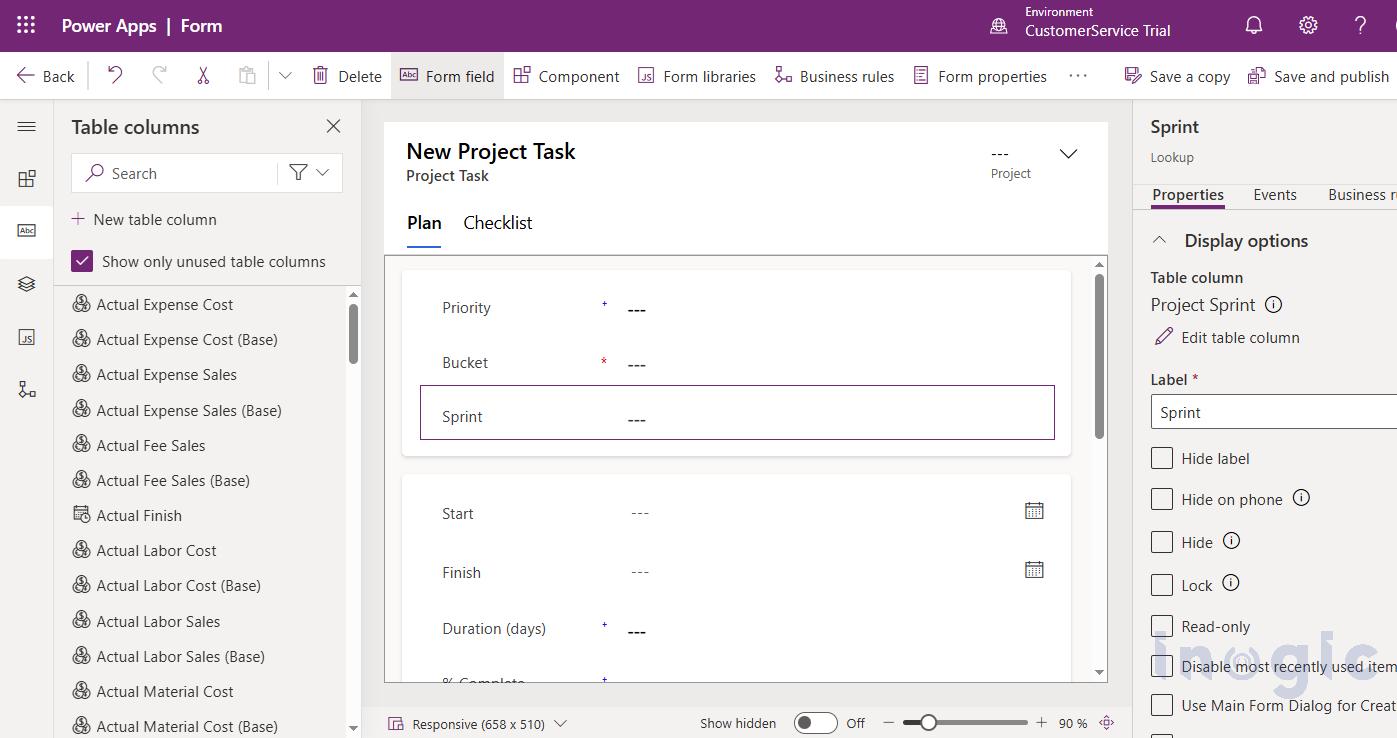
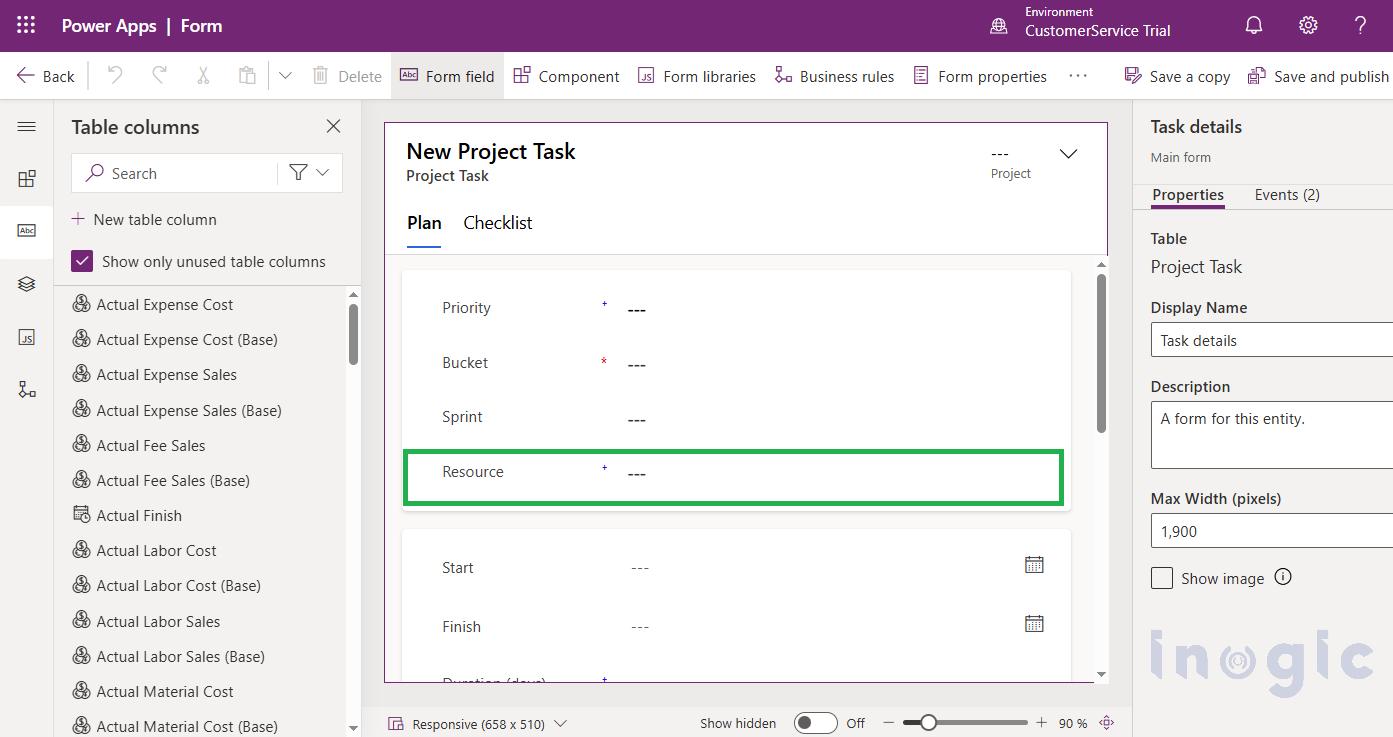
4. Customize the Task details form according to your requirements.

Note: You can customize the task pane whenever you want in Task details and publish it according to your requirements.

How to Customize the Task Pane in Project Operations

Note:  A Resource field is added in Task details form for customization.

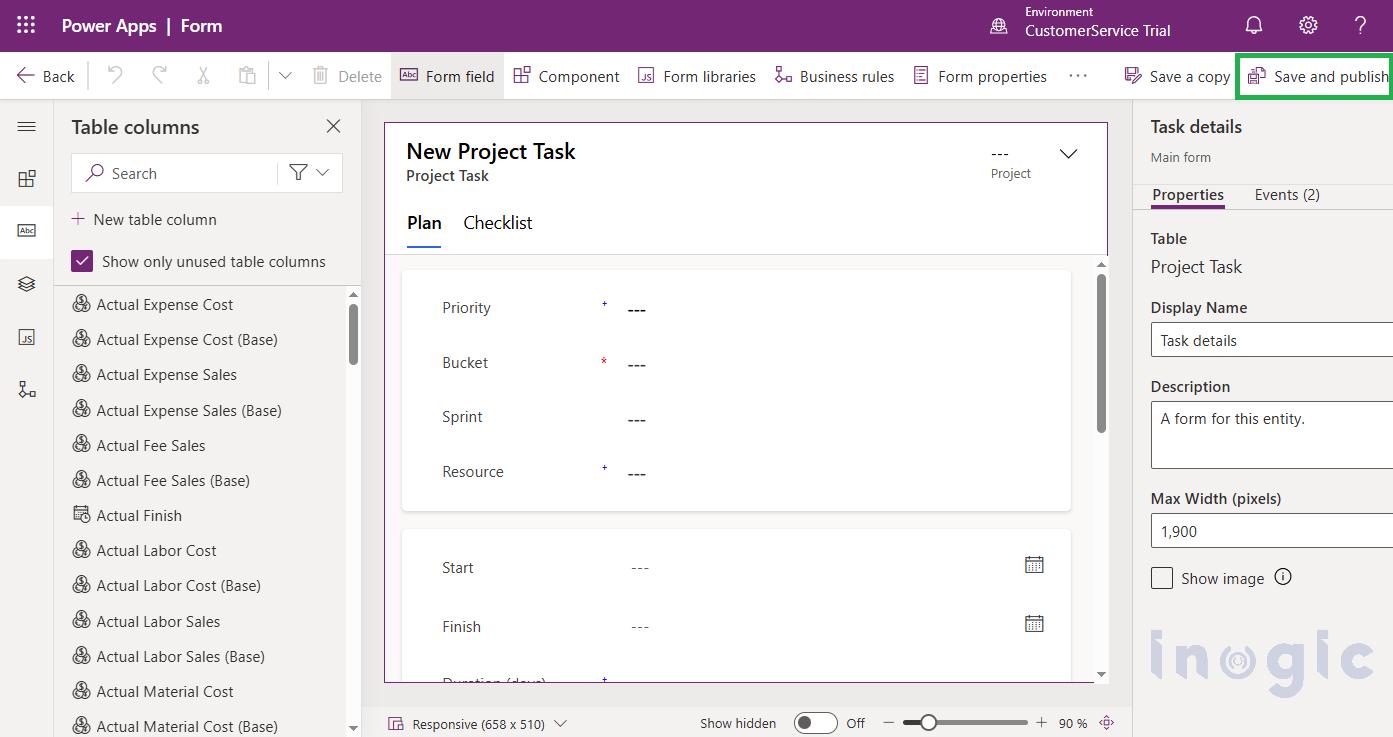
5. Click on Save and Publish button to apply the changes.

How to Customize the Task Pane in Project Operations

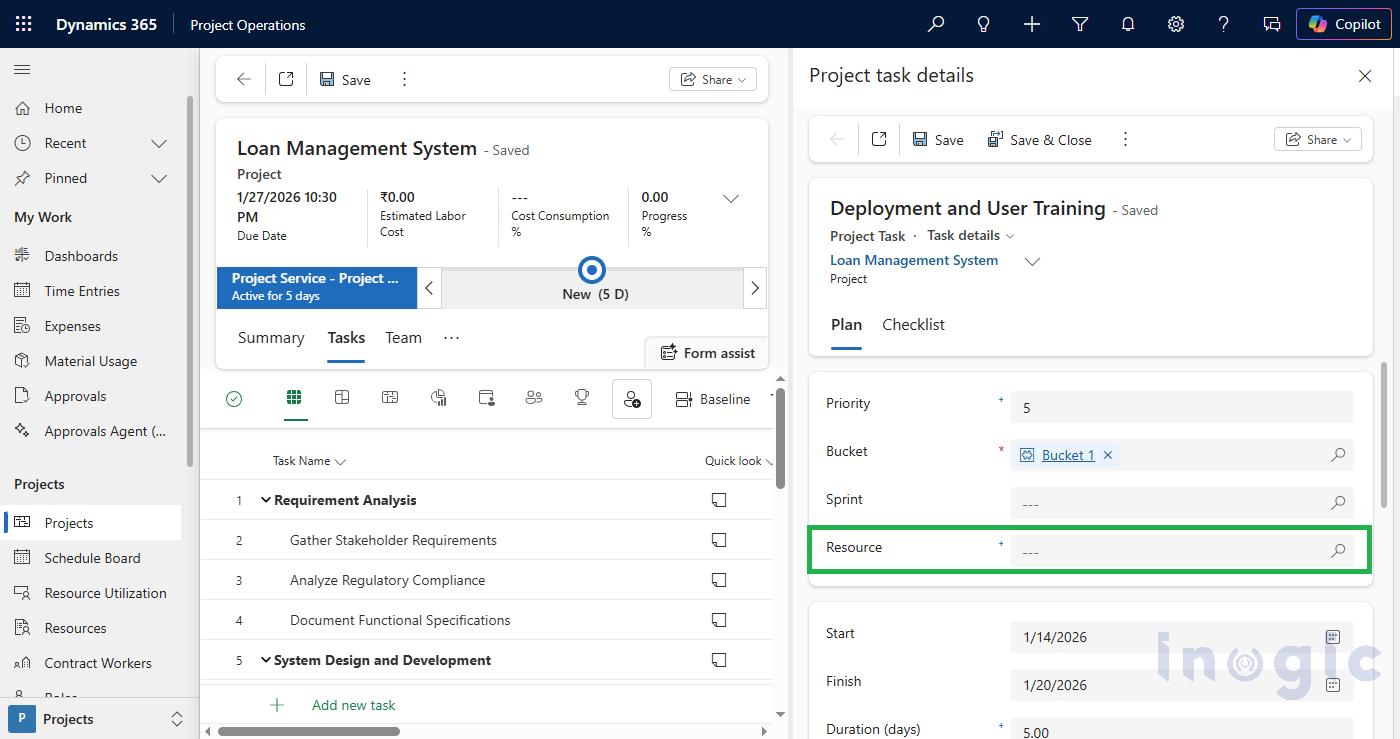
6. Navigate to Project, Click on Tasks tab and click on any Task’s ⓘ icon to view Task details in new Task Side Pane.

How to Customize the Task Pane in Project OperationsNote: Resource field added in Task details form is visible in Task Pane.
Conclusion:

This approach allows us to customize the Task Details form so users can view and update additional task information directly in the Task Side Pane, without navigating away from the task grid.

The post How to Customize the Task Pane in Project Operations first appeared on Microsoft Dynamics 365 CRM Tips and Tricks.

Building Standalone Apps with Power Apps Code Apps: Using Dataverse and Office 365 Users Connectors (Part 1)

Power Apps

In the Dynamics 365 and Power Apps ecosystem, we have several options for building applications, each one is for a specific type of requirement. Model-driven Apps works well when we need a structured UI with standard components, while we use Canvas Apps to create custom, mobile-friendly interfaces with a low-code approach. Recently, Microsoft introduced another application type called Code Apps, which offers a completely different way to build applications using pro code approach.

With the introduction of  Power Apps Code Apps, things have changed. Code Apps let us build standalone single page applications using modern web frameworks. These are independent applications that cannot be integrated with Canvas Apps or Model-driven Apps.

The best part is that we get direct access to more than 1,500 standard and premium connectors through the Power Apps SDK. We do not have to write any authentication code, no OAuth flows, no custom APIs, no middleware. We just have to connect and use.

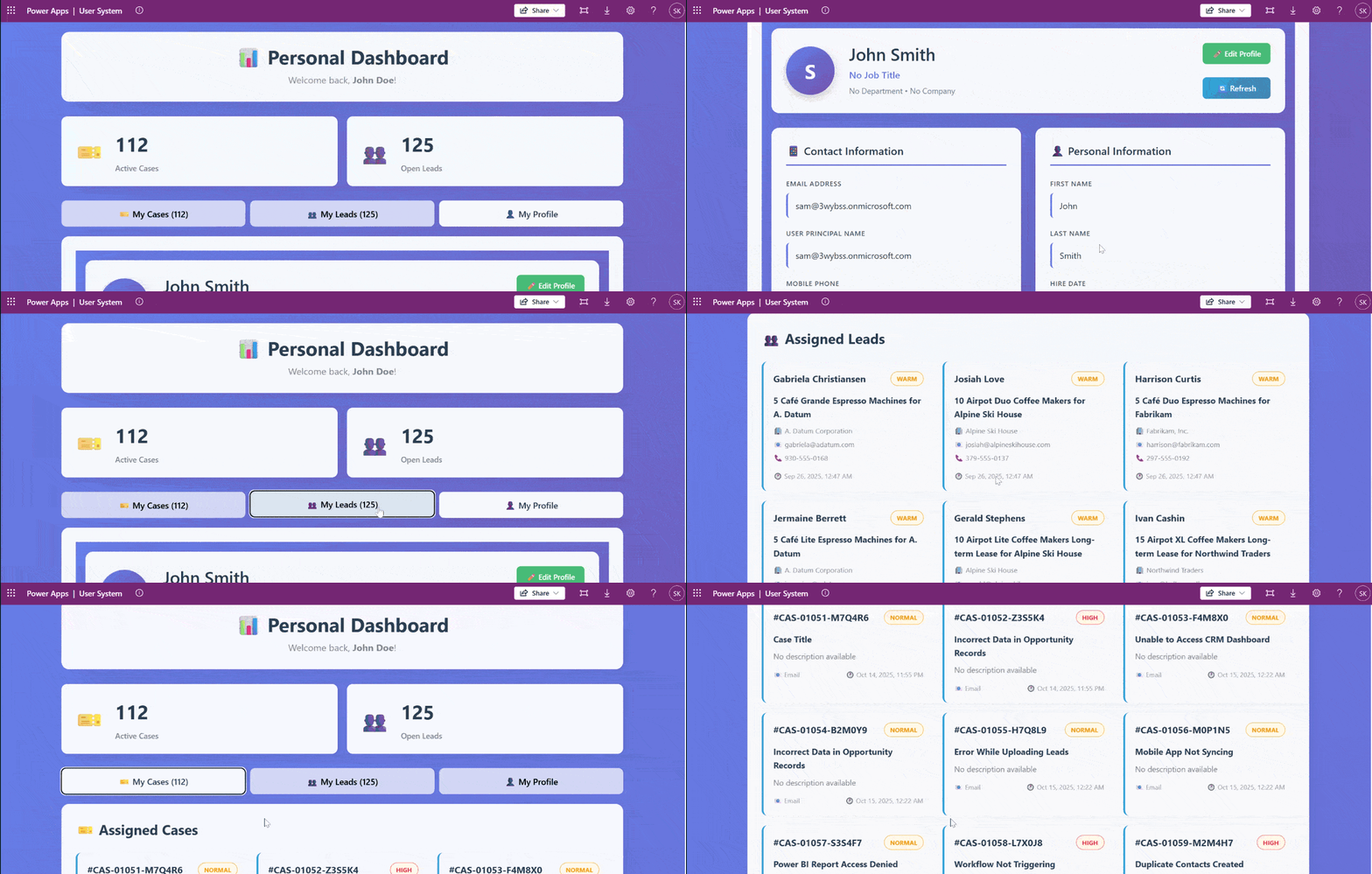
In this article, we’ll walk you through creating a Code App from scratch. We’ll build Personal Dashboard, a simple application that pulls assigned cases and leads from Dataverse and shows current logged in user details using the Office 365 Users and Dataverse connectors.

What Makes Code Apps Different?

We can build a UI of our own choice and connect to a wide range of data sources using more than 1,500 standard and premium connectors provided by the Power Platform. All connections are secure because the Power Apps SDK handles authentication, and each connector enforces user-level permissions. This means the app can only access data that the signed-in user is allowed to see, so there’s no need to write custom authentication code.

Code Apps provide a balanced approach with several key advantages:

  • A standalone application that runs directly within Power Platform
  • Full development with modern web frameworks such as React, Vue, or Angular, with support for  your preferred libraries
  • Direct access to connectors through the Power Apps SDK without custom authentication code
  • Streamlined deployment through a single command to your environment

The connector integration is particularly valuable. Whether the need is to query Dataverse, access current user profile details, or use other services, the connector can be called directly. There’s no need to configure service principals, manage app registrations, or implement token management. The integration works seamlessly within the platform.

Prerequisites

Before getting started, we have to make sure the following prerequisites are in place:

  • Power Apps Premium license with Code Apps enabled environment
  • Visual Studio Code installed
  • Node.js LTS version
  • Power Platform Tools for VS Code extension

Step 1: Setting Up the Code App

Let’s create the app. Open VS Code, launch a PowerShell terminal, and run the following command:

npm create vite@latest PersonalDashboard — –template react-ts

For this application, we are using React as the framework and TypeScript as the variant. After that, navigate to the project folder and install the dependencies:

npm install

Install the node type definitions:

npm i –save-dev @types/node

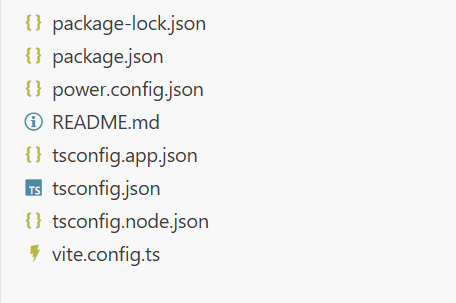
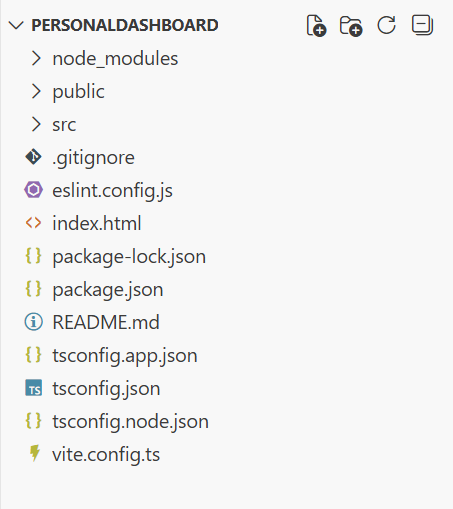
After executing these commands, the project structure will appear as shown in the image below.

PowerAppsCode

According to the official Microsoft documentation, the Power Apps SDK currently requires the port to be 3000 in the default configuration. To configure this, open vite.config.ts and replace the content with the following code:

import { defineConfig } from 'vite'

import react from '@vitejs/plugin-react'

import * as path from 'path'


// https://vite.dev/config/

export default defineConfig({

base: "./",

server: {

host: "::",

port: 3000,

},

plugins: [react()],

resolve: {

alias: {

"@": path.resolve(__dirname, "./src"),

},

},

});

Note for Mac users: It may be necessary to modify the package.json scripts section.

Change from:

"scripts":  {

"dev": "start vite && start pac code run",

"build": "tsc -b && vite build",

"lint": "eslint .",

"preview": "vite preview"

}

to this

"scripts": {
"dev": "vite && pac code run",
"build": "tsc -b && vite build",
"lint": "eslint .",
"preview": "vite preview"
}

Save the file and run the Code App locally by executing:

npm run dev

Browse to http://localhost:3000. If the application loads successfully, press Ctrl+C to stop the server.

Step 2: Initialize the Code App

First authenticate to Power Platform:

pac auth create

After that, sign in with the credentials and select the environment:

pac env select -env <environment-url>

Initialize the Code App:

pac code init –displayName “Personal Dashboard”

This will create a power.config.json file in the project as shown in the image below.

PowerAppsCode

Now install the Power Apps SDK. This package provides APIs that allow the application to interact directly with Power Platform services and includes built-in logic to manage connections automatically as they are added or removed.

npm install –save-dev “@microsoft/power-apps

Update package.json to run both Vite and the Power Apps SDK server:

"scripts": {
"dev": "start pac code run && vite",
"build": "tsc -b && vite build",
"lint": "eslint .",
"preview": "vite preview"
}

Step 3: Configure Power Provider


Create PowerProvider.tsx under src and add the Power SDK context provider code given below.


import { initialize } from "@microsoft/power-apps/app";

import { useEffect, type ReactNode } from "react";

interface PowerProviderProps {

children: ReactNode;

}

export default function PowerProvider({ children }: PowerProviderProps) {

useEffect(() => {

const initApp = async () => {

try {

await initialize();

console.log('Power Platform SDK initialized successfully');

} catch (error) {

console.error('Failed to initialize Power Platform SDK:', error);

}

};

initApp();

}, []);

return <>{children}</>;

}

Update the main.tsx and add this line in the imports section:

import PowerProvider from './PowerProvider.tsx'

and change this code snippet

<StrictMode>
<App />
</StrictMode>,

to this

<StrictMode>

<PowerProvider>

<App />

</PowerProvider>

</StrictMode>,

Run the app by executing :

npm run dev

Open the URL provided by the Power SDK Server in the same browser profile as that of power platform tenant.

Step 4: Adding Dataverse Connector

Now comes the part where we will add the data source to our application. In this step, we’ll use the Dataverse connector to fetch assigned cases and leads for the logged-in user.

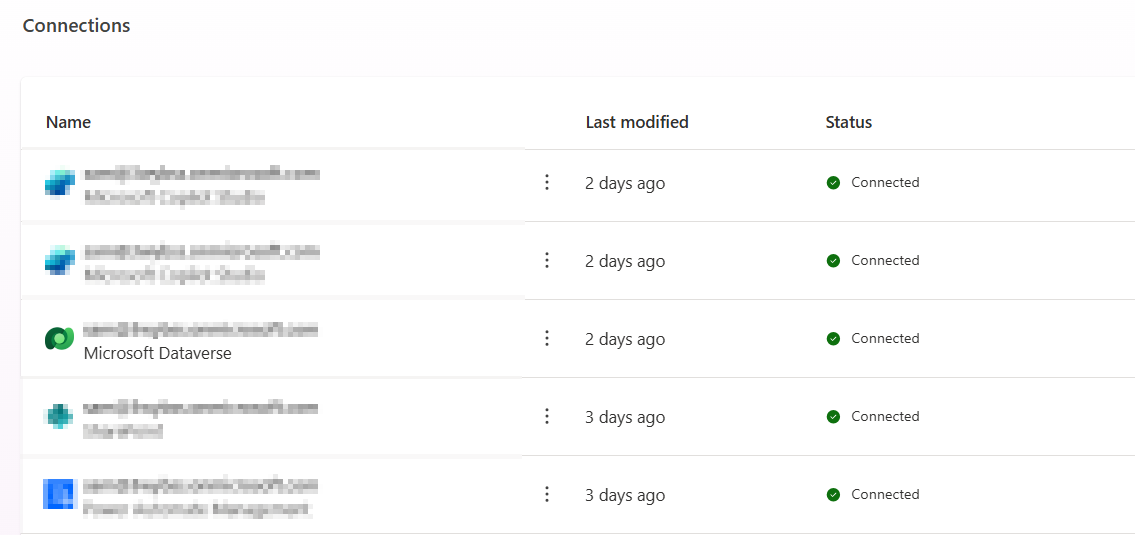
For that First, we need to create a connection:

1. Go to Power Apps and open Connections.

2. Click New Connection and select Dataverse.

Follow the instruction properly to create the connection, as shown in the

PowerAppsCode

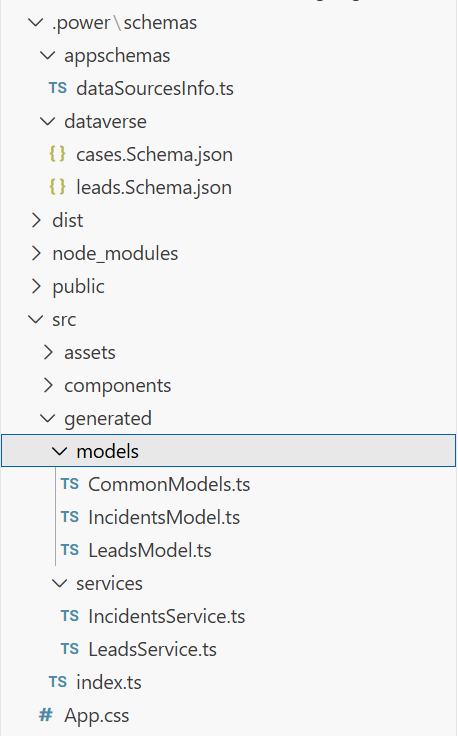
Once the connection is ready, we have to open the terminal. For Dataverse, we have to add the tables required for the application. For this example, we’ll add the Leads and Incident (Cases) tables using the following commands:

pac code add-data-source -a dataverse -t lead

pac code add-data-source -a dataverse -t incident

PowerAppsCode

After running these commands, we can see that some files and folders are added to the project. Inside the generated folder, there are services and models folders. These contain the files for Leads, Incidents, and other tables, which can be used in the code. For example:

import { AccountsService } from './generated/services/AccountsService';

Import type { Accounts } from './generated/models/AccountsModel';

CRUD operations can be performed on Dataverse using the app. Before accessing any data, we have to initialize the Power Apps SDK to avoid errors. An async function or state check can ensure the SDK is ready before making API calls. For example:

useEffect(() => {

// Define a function of asynchronous type to properly initialize the Power Apps SDK to avoid any error during runtime


const init = async () => {

try {

await initialize(); // Wait for SDK initialization

setIsInitialized(true); // Mark the app as ready for data operations

} catch (err) {

setError('Failed to initialize Power Apps SDK'); // Handle initialization errors

setLoading(false); // Stop any loading indicators

}

};


init(); // Call the initialization function when the component mounts

}, []);


useEffect(() => {

If (!isInitialized) return;


// Place your data reading logic here

}, []);


Step 5: Adding Office 365 Users Connector

Similar to Dataverse, we need to create a connection for Office 365 Users by following the same steps. Once the connection is ready, we need to add it to the application. First, list all available connections to get the connection ID using command:

pac connection list

It will list all the connections available in the selected environment. We need to Copy the connection ID for Office 365 Users from the list, then add it to the project using:

pac code add-data-source -a “shared_office365users” -c “<connection-id>”

After running this command, the Office 365 Users connector will be available to use in the application, allowing access to user profiles, and other Office 365 user data.


Step 6: Building the UI

There are two ways to build a good UI. The first is the traditional coding approach where we write the complete code manually. The second is by using GitHub Copilot integrated in VS Code with the help of prompts.

Using GitHub Copilot:

We can generate the UI by writing a detailed prompt in GitHub Copilot. Here’s an example prompt:

Create a Personal Dashboard UI component in React with TypeScript that displays:

  1. A header section showing the current logged-in user’s profile information (name, email, job title, and profile photo) fetched from Office 365 Users connector
  2. Two main sections side by side:

– Left section: Display a list of assigned Cases (Incidents) from Dataverse

* Show case title, case number, priority, status, and created date

* Use card layout for each case

* Add loading state and error handling

– Right section: Display a list of assigned Leads from Dataverse

* Show lead name, company, topic, status, and created date

* Use card layout for each lead

* Add loading state and error handling

  1. Use modern, clean UI design with:

– Responsive layout (works on desktop and mobile)

– Tailwind CSS for styling

– Professional color scheme (blues and grays)

– Proper spacing and typography

– Loading spinners while data is fetching

– Error messages if data fails to load

After providing this prompt to GitHub Copilot, it will generate the complete component code. We can then review the generated code, make any necessary adjustments, and integrate it into our application.

Step 7: Deploy Your Code App

Once the code is complete and the app is running locally, the next step is to deploy the application. For Code Apps, deployment is straightforward. First, build the application by running:

npm run build

After a successful build, execute the following command to push the application to Power Apps:

pac code push

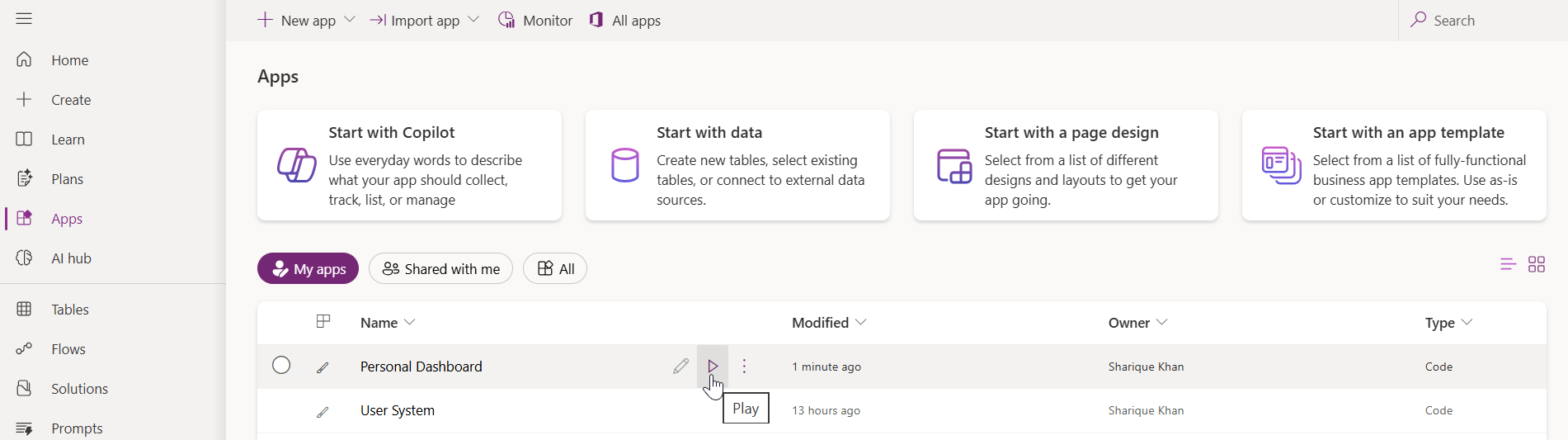
This command will deploy the application to Power Apps. To verify the deployment, go to the Power Apps portal and open the Apps section. The newly deployed Code App will be visible in the list as shown in the image below.

PowerAppsCode

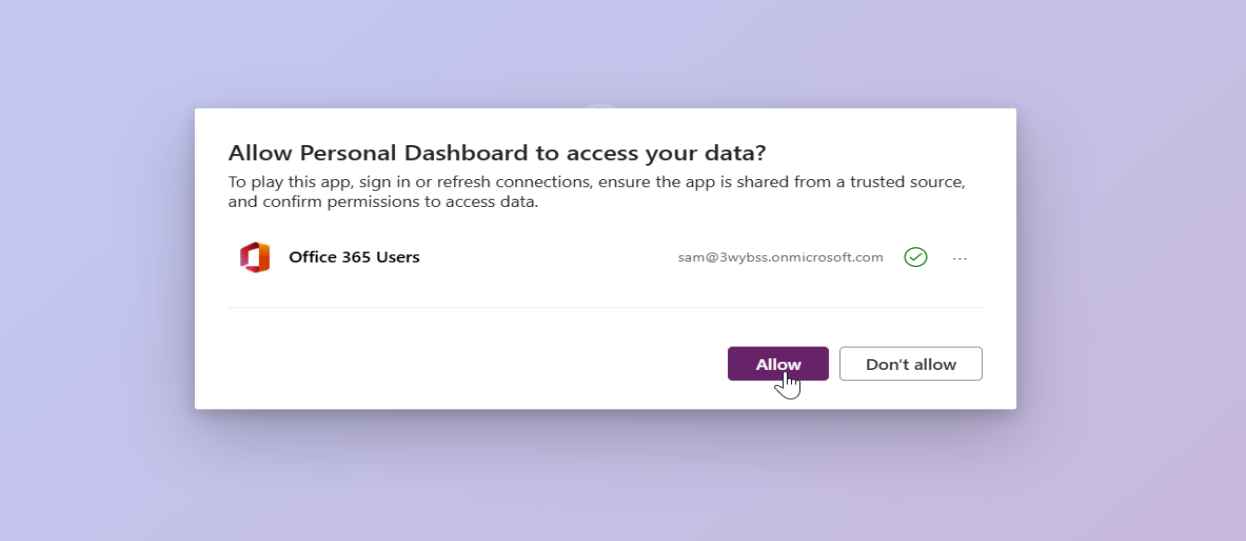
To run the app, click the play button. On the first launch, the application will prompt for permission to access the connected data sources. After allowing the permissions, the application will use those connection references for all subsequent operations.

PowerAppsCode


PowerAppsCode

Conclusion

With Power Apps Code Apps, we can now build standalone applications. The real advantage here is the direct access to over 1,500 connectors through the Power Apps SDK. We can connect to Dataverse, Office 365 Users, and other services without writing any authentication code. The Power Apps SDK handles all the security, and each connector respects user level permissions automatically.

We also get complete freedom to design our own UI using any libraries we prefer. The deployment process is simple. Just run the build command and push it to Power Platform with a single command.

In this article, we built a Personal Dashboard that pulls data from Dataverse and Office 365 Users. The same approach works for any application that needs to connect with Power Platform services. The setup is straightforward, and once the project is initialized, adding new data sources is just a matter of running a few commands.

Code Apps provide a practical way to build custom applications within the Power Platform ecosystem while maintaining secure connections and proper access control.

Frequently Asked Questions (FAQs)

What are Power Apps Code Apps?

Power Apps Code Apps are a new application type in Microsoft Power Platform that allow developers to build standalone single-page applications using modern web frameworks such as React, Angular, or Vue. They provide direct access to Power Platform connectors through the Power Apps SDK without requiring custom authentication code.

How are Code Apps different from Canvas Apps and Model-Driven Apps?

Unlike Canvas Apps and Model-Driven Apps, Code Apps:

  • Are fully standalone applications
  • Use a pro-code development approach
  • Allow complete control over UI and application architecture
  • Cannot be embedded into Canvas or Model-Driven Apps
  • Use modern frontend frameworks instead of low-code designers

Do Power Apps Code Apps require authentication setup?

No. Authentication is handled automatically by the Power Apps SDK. Developers do not need to implement OAuth flows, manage tokens, or configure app registrations. All connectors enforce user-level permissions by default.

Can Power Apps Code Apps connect to Dataverse?

Yes. Power Apps Code Apps can connect directly to Dataverse using the Dataverse connector. Developers can perform CRUD operations on Dataverse tables, such as Leads and Incidents once the SDK is initialized.

How do Code Apps access Office 365 user information?

Code Apps use the Office 365 Users connector to retrieve profile details such as name, email, job title, and profile photo. The connector respects the signed-in user’s permissions automatically.

The post Building Standalone Apps with Power Apps Code Apps: Using Dataverse and Office 365 Users Connectors (Part 1) first appeared on Microsoft Dynamics 365 CRM Tips and Tricks.

Build AI-Powered Apps in Minutes with Power Apps Vibe: A Complete Guide (Preview)

Power Apps Vibe

If you’ve ever tried building apps with Microsoft Power Apps, you know the process: creating tables, designing screens, adding controls, connecting data, and writing formulas. While the traditional app-building process is effective, it can also be time-consuming and complex.

But now, imagine this:

You simply describe the app you need, and within minutes, Power Apps Vibe takes over:

  • A complete data model is generated.
  • UI screens are automatically designed.
  • Built-in logic is incorporated.
  • A functional prototype is ready to go.

All this, without having to drag a single control or write a line of code.

Welcome to Power Apps Vibe—a revolutionary AI-powered app development platform. Unlike traditional app design methods, Power Apps Vibe makes building apps simpler, faster, and more intuitive than ever before.

Instead of spending hours designing screens and wiring logic, Vibe transforms app development into a simple, conversational experience. You describe what you need, and it creates the foundation for your app—data model, UI, navigation, and logic—automatically.

Power Apps Vibe

In this blog, I’ll break down what Vibe is, why Microsoft created it, and how you can start building full-stack apps with nothing more than a sentence.

What is Power Apps Vibe?

Power Apps Vibe is Microsoft’s AI-driven app-building experience, designed to simplify app development. Available now in preview, this feature combines the best aspects of low-code and AI-powered development into a single, seamless interface.

Unlike traditional app-building tools such as Canvas or Model-Driven apps, Vibe functions like a creative partner, helping you bring your app ideas to life faster. Here’s how it works:

  • You describe your app’s requirements in simple language.
  • Power Apps Vibe automatically creates:
    • The data model behind your app.
    • The UI screens you need.
    • Navigation and action flows.
    • The core logic for functionality.

You still have full control to modify or refine any aspect of the app. Think of Power Apps Vibe as a combination of Power Apps, an AI architect, a UI designer, and a developer, all within a single interface.

Think of it as Power Apps + a smart architect + a designer + a developer, all rolled into one interface.

Why Did Microsoft Introduce Power Apps Vibe?

The goal behind Power Apps Vibe is simple: to make app development faster, smarter, and more accessible for everyone, from business users to developers.

Organizations often face challenges such as:

  • Long development cycles
  • Lack of skilled developers
  • Difficulty translating business ideas into working apps
  • Fragmented requirements
  • Slow prototype development

Power Apps Vibe addresses these issues by enabling anyone, whether a business user, analyst, or developer, to rapidly create a solid app foundation. With Vibe, you can skip the time-consuming setup and dive straight into customizing the app for your specific needs.

We can maintain full control for customization, but the time-consuming initial setup is handled for us.

Where Do You Access Power Apps Vibe?

Currently, Power Apps Vibe is available in preview and is not yet part of the standard Power Apps studio. To get started, head over to the preview portal: Power Apps Vibe Preview

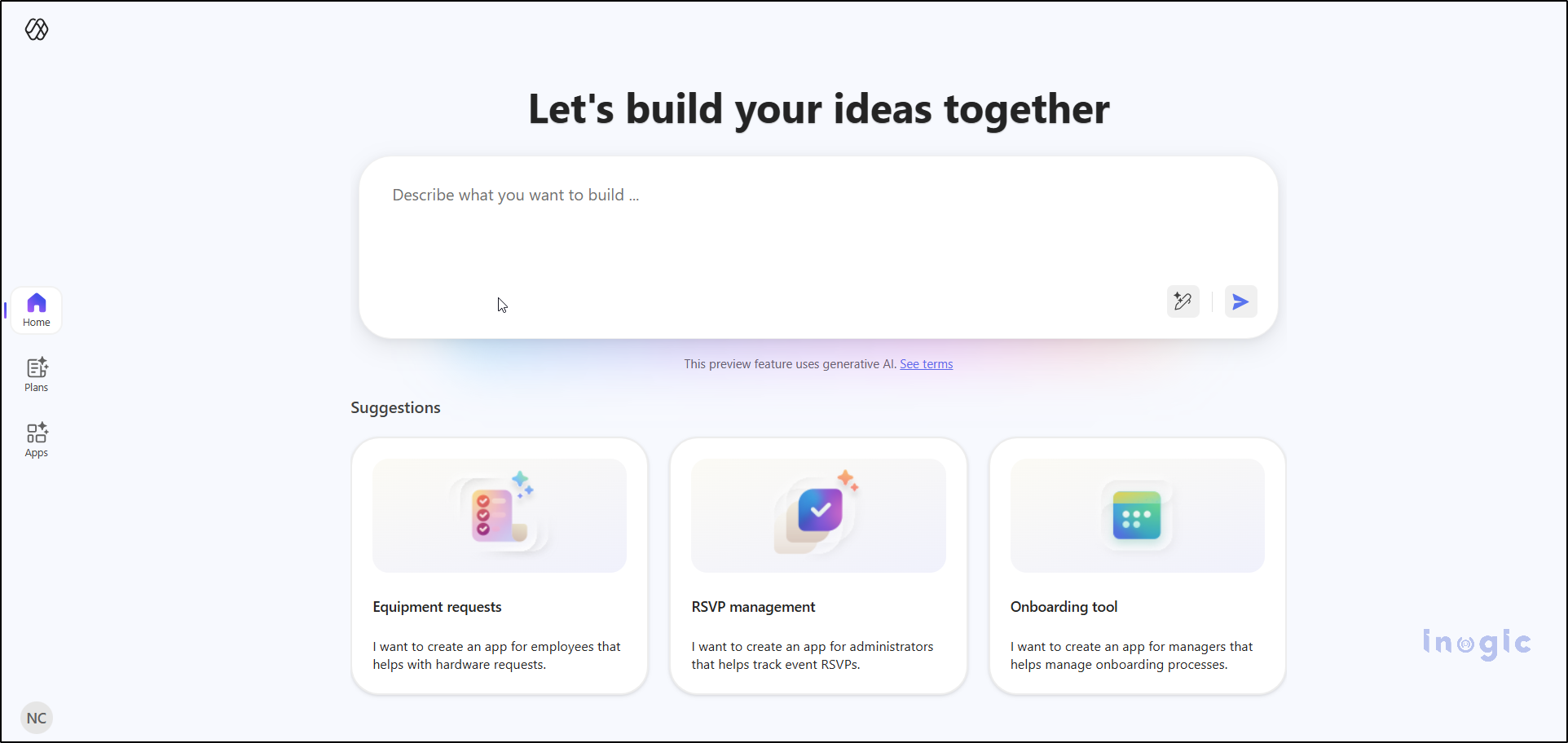
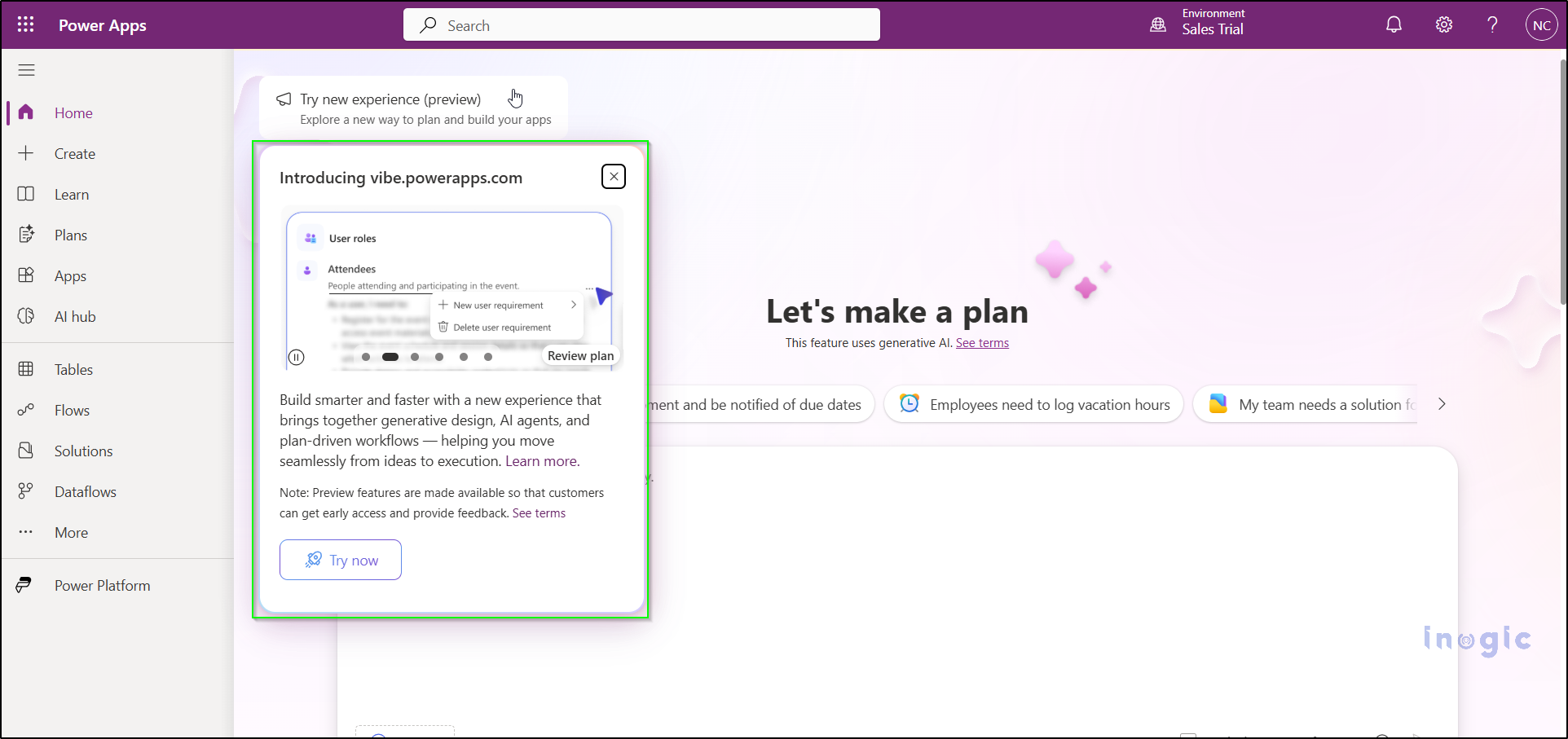
Simply sign in with your Microsoft account, and you’ll be greeted with a clean, intuitive workspace. A large prompt box will be ready for your ideas, making it easy to get started.

Power Apps Vibe

To use it, Navigate to:

🔗 https://vibe.preview.powerapps.com

Sign in with your Microsoft account, and you’ll enter a clean, streamlined workspace featuring a large prompt area—ready for your ideas.

How to Build an App Using Vibe?

Step-by-Step Guide to Building an App with Power Apps Vibe

Here’s what surprises most people:

Using Power Apps Vibe feels less like coding and more like having a conversation with a colleague. You describe what you need, and Vibe does the heavy lifting. Here’s how the process works:

Let’s walk through the complete process step by step.

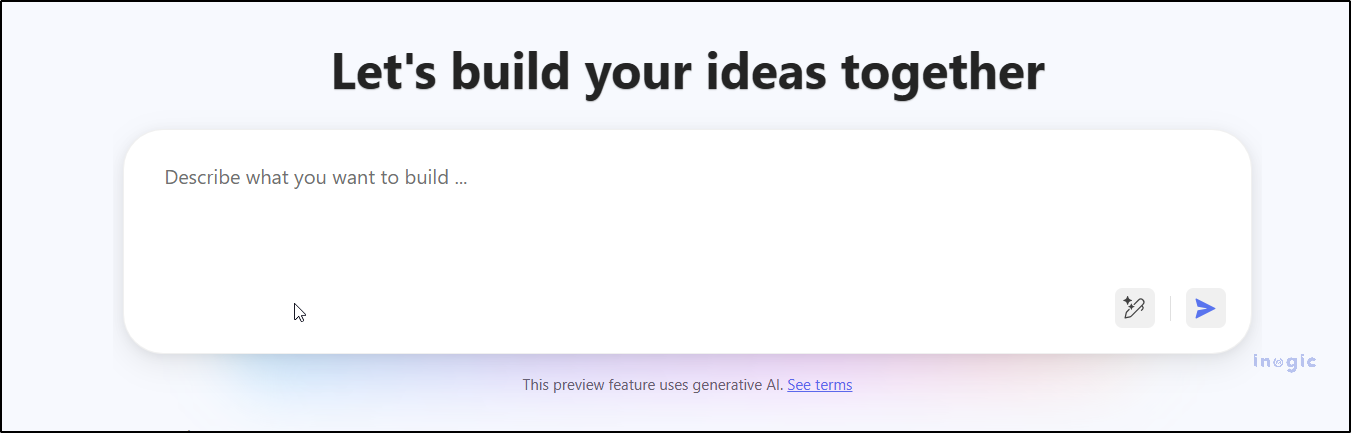
Step 1: Describe the App You Want

In the prompt box, simply describe your app in plain language. You don’t need to worry about technical jargon or formatting. For example:

“I want to build a Time Entry Admin app. Admins should be able to update the Base Pay Code, view a list of time entries, and edit the Base Pay Code only on this screen.”

Power Apps Vibe

No need for complex formatting or technical jargon.
Just describe your app idea as if you were explaining it to a teammate – simple, clear, and conversational.

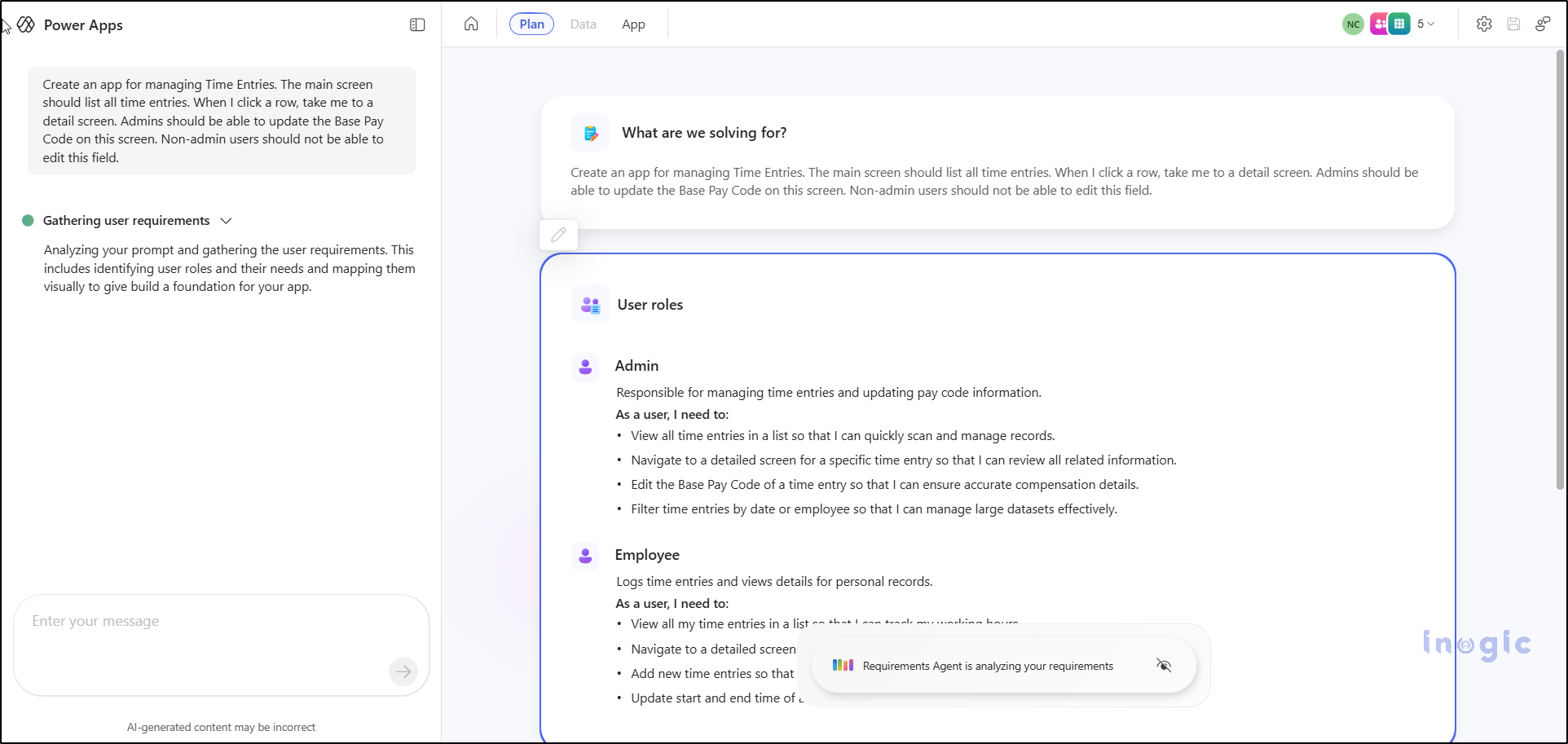
Step 2: Vibe Generates Your App Plan

Once you submit your prompt, Vibe analyses your requirements and generates a detailed plan. This blueprint typically includes:

  • The tables it will create
  • The fields within those tables
  • The screens your app will have
  • Actions and commands for functionality
  • Navigation flow between screens

Test Prompt:

“Create an app for managing Time Entries. The main screen should list all time entries. When I click a row, take me to a detail screen. Admins should be able to update the Base Pay Code on this screen. Non-admin users should not be able to edit this field.”

Power Apps Vibe

It’s essentially the blueprint of your app. If something doesn’t look right, you don’t need to start over – just refine your prompt. For example:

  • Add an audit field
  • Change the name of this table
  • Make Base Pay Code read-only for non-admins

Vibe instantly updates the plan based on your instructions, making the process feel conversational and effortless.

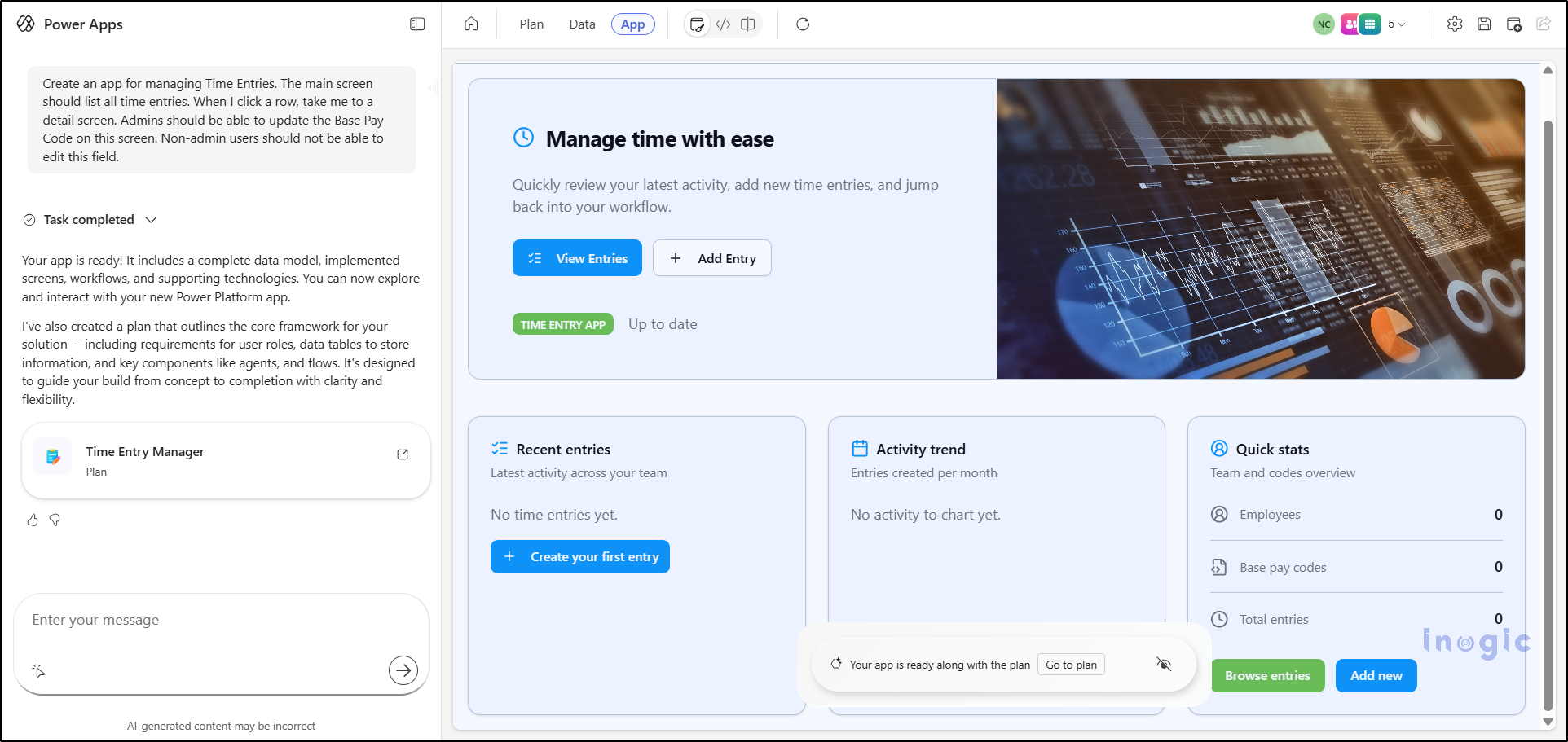
Step 3: Create the App

Once your plan looks good, simply click Create App.

Vibe now builds:

  • The user interface (UI)
  • Interactive forms
  • The underlying data model
  • Core logic for functionality

This process yields a functional web application that is available for immediate preview.

Power Apps Vibe

Vibe handles all the heavy lifting so you can focus on refining ideas instead of wrestling with syntax.

Step 4: Refine the App Through Natural Language

This is where Vibe feels different from anything we’ve seen before.

You can simply chat with it:

  • “Make the Base Pay Code field bigger.”
  • “Add a dashboard screen with totals.”
  • “Add a search bar at the top.”
  • “Show only records assigned to the logged-in user.”

And Vibe will update the app instantly.

It’s the first time Power Apps feels like a conversation instead of a tool.

Step 5: Save Your App

When you save the app for the first time, Power Apps stores:

  • the app
  • the plan
  • the screens
  • and the data model

All inside a single solution.

It becomes part of your Power Apps environment, just like any other app.

Step 6: Connect to Real Data (Optional)

When you first build the app, it uses “draft data” –  temporary tables that exist only for prototyping.

Once your app is ready for real use:

  1. Go to Data
  2. Connect to Dataverse, SQL, SharePoint, or any supported source
  3. Map the fields
  4. Publish the app again

This step turns your prototype into a production-ready application.

Step 7: Publish and Share

Once everything looks right, click Publish.

Your app becomes live, and you can share it with your team exactly like any other Power App.

Where Power Apps Vibe Really Shines

After playing with it, I realized Vibe is perfect for:

  • Rapid prototyping
  • Converting ideas into real apps within minutes
  • Building admin tools
  • Internal dashboards
  • Small line-of-business apps
  • Automating manual processes
  • Mockups for client demos
  • Reducing the back-and-forth between business teams and developers

It reduces friction. It reduces waiting. It reduces technical complexity.

You still get full control — formulas, data, actions, security, connectors — everything you normally have in Power Apps remains available.

But the start is dramatically faster.

Limitations to Keep in Mind for Power Apps Vibe

Since Vibe is still a preview feature, a few things have limitations:

  • You cannot edit Vibe apps in the classic Canvas app studio.
  • If you export/import the solution, it may break the link with the AI “plan.”
  • It currently supports creating only one app per plan.
  • Existing Dataverse tables aren’t automatically suggested during generation.
  • Some refinements still need to be done manually.

But even with these limitations, Vibe is powerful enough to start real-world projects and prototypes.

Final Thoughts

Power Apps Vibe is one of the biggest updates to the Power Platform in years.
It brings a fresh, modern, conversational style of development that feels more natural and less stressful.

Instead of spending hours designing screens and wiring logic, you can now focus on:

  • Refining ideas,
  • Improving workflows,
  • And delivering value faster.

If you haven’t tried it yet, open the preview today and type the first idea that comes to mind.
You’ll be surprised how quickly it becomes a working app.

Frequently Asked Questions: Power Apps Vibe

1. What is Power Apps Vibe and how is it different from traditional Power Apps development?

Power Apps Vibe is an AI-powered app-building tool that allows you to create full-stack apps simply by describing your requirements in natural language. Unlike traditional Power Apps, which involve manually designing screens and writing formulas, Vibe automatically generates the data model, UI, navigation, and logic. It simplifies app development by transforming it into a conversational, automated process.

2. Can I use Power Apps Vibe without any coding knowledge?

Yes, Power Apps Vibe is designed for users with little or no coding experience. It allows you to create apps by simply describing what you want in plain language. The AI handles the complex aspects of app development, such as data modeling, UI design, and logic, so you can focus on refining your ideas rather than writing code.

3. Is Power Apps Vibe available for all users or only those in certain regions?

Currently, Power Apps Vibe is in preview and can be accessed by users who sign in through the dedicated portal at https://vibe.preview.powerapps.com. While the feature is available globally, its availability might vary based on regional preview settings and Microsoft’s rollout timeline. Keep an eye on updates for broader access.

4. What are some limitations of Power Apps Vibe?

While Power Apps Vibe is a powerful tool, it does have some limitations:

  • You cannot edit Vibe-generated apps in the classic Canvas App Studio.
  • The feature currently supports only one app per plan.
  • Existing Dataverse tables aren’t automatically suggested during the app creation process.
  • Some refinements still require manual adjustments after the initial app is generated.

5. How can I connect my Power Apps Vibe app to real data?

Once your prototype is ready, you can connect your Power Apps Vibe app to real data by navigating to the Data section within Power Apps and linking it to supported data sources such as Dataverse, SQL, or SharePoint. After mapping the fields, you can publish the app again to make it production-ready.

The post Build AI-Powered Apps in Minutes with Power Apps Vibe: A Complete Guide (Preview) first appeared on Microsoft Dynamics 365 CRM Tips and Tricks.

My first XRMToolBox Plugin: Dataverse Users, Security roles, Teams and Teams security roles

Logos featuring a stylized letter 'D' in blue and a wrench icon next to a blue and red graphic element.

I recently released my first XRMToolBox plugin, “Dataverse Users, Security Roles, Teams and Teams Security Roles,” designed to help administrators, developers, and auditors easily explore detailed user access data within Microsoft Dataverse environments.

You can check the below articles in order for more details.

Hope you liked my new XrmToolBox tool “Dataverse Users, Security roles, Teams and Teams security roles“.

Please like and share your valuable feedback on this article. Also, follow my blog to get my articles to your Inbox.

Click on the below image to navigate to my YouTube Channel.

Graphic promoting a YouTube channel with the text 'Has my blog post helped you?' and buttons for 'WATCH', 'LEARN', and 'SUBSCRIBE'.

Below are my earlier articles that you can have a look.

My first XRMToolBox Plugin: Dataverse Users, Security roles, Teams and Teams security roles (Usage)

My first XRMToolBox Plugin: Dataverse Users, Security roles, Teams and Teams security roles (Installation)

My first XRMToolBox Plugin: Dataverse Users, Security roles, Teams and Teams security roles (Overview)

Limited Time Offer: 50% Off Microsoft Certification Vouchers

How to send an automated email in Dataverse using Power Automate?

Understanding Activity Party Types in Dynamics 365 CE

How to configure donotreply email using Shared mailboxes in Dynamics 365 CE?

Microsoft Power Pages: The authentication key for your portal will expire

Microsoft Azure: You’re not eligible for an Azure free account

How to create Microsoft Azure 30 days trial?

Edit in Visual Studio Code for the Web in Power Apps Portals

Error: The object cannot be updated because it is read-only in Microsoft Power Apps

Resolved: Fix connections issue in Power Automate Flow

Clear all objects feature in Power Apps Solutions

Power Automate Error: The ‘inputs.parameters’ of workflow operation of type ‘OpenApiConnection’ is not valid.

Power Automate Error: To use FilteringAttributes, your trigger must include an Update event on Dataverse Trigger

Dynamics 365 CE Solution Import Failed in Azure DevOps Pipelines

Power Automate Error: Cannot write more bytes to the buffer than the configured maximum buffer size: 104857600

Error while opening a Tool in XRMToolBox

The Power Automate Cloud Flows Best Practices Whitepaper is now LIVE!

Error in Power Automate: There’s a problem that needs to be fixed to trigger this flow. To see more details, open Flow checker.

How to get the Dataverse Table’s first row from List Rows in Power Automate?

Microsoft Dataverse Accelerator – Part 2 – Installation

Microsoft Dataverse Accelerator – Part 1 – Introduction

How to get the Database Version of the Dataverse?

API playground feature not available in Dataverse Accelerator App?

How to Explore and test Dataverse in the Web API playground (preview)?

Web resource method does not exist in Dynamics 365 CE

How to get Environment Variable Value in Dynamics 365 CE using JavaScript?

Model-driven Apps – openAlertDialog – JavaScript – Code Snippet

Power Automate – Flow is not running on Trigger condition

Power Automate – Input field Delete option is disabled

Recipient of type ‘Contact’ with ID is marked as non-emailable

Preferred Solution | New feature | Microsoft Dataverse

New and Retired Microsoft Dynamics 365 Certifications

Environment settings behavior (Preview) feature in Model-driven Apps

Error while connecting to Dataverse environment in XrmToolBox

Power Fx Formula Columns in Microsoft Power Apps

How to Enable 2024 Release Wave 1 Updates in the Microsoft Dynamics 365 CE Environment?

Delete and Restore records (Preview) feature in Microsoft Dataverse

Microsoft Power App Environments Retention Period

How to Override the Model-driven app header colors?

Timeline Highlights (New feature) in Microsoft Power Apps

Model-driven App – Cannot “See associate records” option in the sub grid (arunpotti.com)

Bookmark the Important Dynamics 365 URLs

How to Enable Tenant-level analytics for Power Automate and Power Apps?

Microsoft Power Automate Copy and Paste Action in New DesignerHow to Setup Multi-Factor Authentication for your Microsoft Power Apps environment?

Microsoft Power Apps | Modern Themes | Preview feature

How to Download and Install the .NET Framework?

How to Create a SharePoint Site Online?

How to add and use Copilot answer control (Preview) in Microsoft Power Apps?

Dark Mode in Microsoft Power Apps

How to create Microsoft 365 E3 Trial for 30 days?

Refreshed look of solution dependencies in Dataverse Solutions

Microsoft Power Automate | Version History | Restore | New Feature

MICROSOFT LEARN – Artificial Intelligence Skills Challenge​ 2024!!!

Resolved – ‘InvokerConnectionOverrideFailed’ Error When a Power App Custom Page call a Power Automate Flow

How to Create Microsoft Power Apps Trial 30 days?

Not able to Create Power Automate Flow in Custom Page in Model-Driven App?

How to Enable Inline Actions feature in Microsoft Canvas Apps?

How to use /mention in Outlook web client for Dataverse records?

Associate Activities Multiple Related Records (Preview) feature in Microsoft Dynamics 365 CE

How to Enable Aggregation (preview) feature in Microsoft Power Apps?

Power Apps – Some components of this app require you to sign in. If you don’t sign in, part of the app may not work.

How to Enable the SQL Server stored procedures (preview) feature in the Power Apps?

How to get the Client Version of the Model Driven Apps?

How to get Microsoft 365 E3 Trial for 30 days?

How to Enable Copilot for Model-Driven apps feature in Dynamics 365 CE Environment?

[Resolved] Web resource method does not exist in Dynamics 365 CE JavaScript Error

How to Enable Blocking unmanaged customizations (Preview) feature in Dynamics 365 CE?

How to create Microsoft Power Apps Developer Plan Environment?

Microsoft Power Apps Developer Plan vs Power Apps Trial 30 days

What is Microsoft Power Apps Developer Plan?

[Resolved] PCF Field Control not showing anything in the PCF Test Environment?

[Issue Resolved] ReferenceError: Web resource method does not exist in Dynamics 365 CE Javascript Error

[Issue Resolved] Subcomponent cannot be added to the solution because the root component Template is missing in Dataverse

How to Turn Off the Modern Look in the Model Driven Apps?

How to Turn on the New modern, refreshed look for the Model-Driven apps?

Microsoft Power Apps – Apps filter feature

How to Create Microsoft Power Apps 30 days Online Trial Version and an Environment?

Microsoft Power Apps – Solutions filter Preview feature

How to Show the Power Automate complete Expressions?

Dataverse Error: Cannot start the requested operation [EntityCustomization] because there is another [PublishAll] running at this moment.

Power Automate Error: You should specify a contact or account.

How to get the Choice Text and Value in the Dataverse using JavaScript?

Microsoft Dataverse Low Code No Code Plugins

How to convert the Number String to Number Array?

How to Integrate Instant Plugins in the Power Automate Flow?

Power Apps – ‘actionname’ is an unknown or unsupported function in namespace ‘Environment’

Dataverse Browser V1.1.0.1 is available for Dataverse Plugin Debugging

How to Integrate Instant Plugins in the Canvas App?

How to Enable Access to Microsoft Dataverse Actions (Preview feature) in the Power Apps?

How to Create an Instant Plugin in the Dataverse Environment?

How to Install the Microsoft Dataverse Accelerator in the Dataverse Environment?

What is Microsoft Dataverse Accelerator?

How to get the Logged in User Information in the Power Apps?

How to Install Power Platform Tools in Visual Studio Code?

How to Install the Apps from the Microsoft AppSource to your Dataverse Environment?

Microsoft Power Apps Maker Portal has a new look

Microsoft Power Apps Emulator (New Feature)

How to Enable the Dataverse Offline (Experimental Feature) in the Canvas Apps?

How to set the Authoring Version in the Canvas App?

New version of Dataverse Browser is available for Dataverse Plugin Debugging

Latest Free Practice Assessments for Microsoft Certifications

Download CRM 365 V9.X Tools using PowerShell

How to set the Refresh cadence for a Power Platform Environment?

Update forms and views (Preview feature) in Dataverse

How to connect to Microsoft Dataverse in Power Automate Flow using Service principal?

How to Enable Copilot (Preview) feature in Canvas Apps?

How to Debug a Dataverse Plugin without Installing the Profiler in the Plugin Registration Tool?

How to Enable the Licenses (Preview) feature for a Power Platform Environment?

How to Enable Maker Welcome Content (preview) in Power Apps Maker Portal?

How to Enable Managed Environments for a Dataverse Environment?

How to Enable the Modern Controls (Preview feature) in the Canvas Apps?

How to Enable 2023 Release Wave 1 updates in the Dataverse Environment?

How to Deploy Enterprise Applications in the new Dataverse Environment?

What is Preview, Experimental and Retired features in Canvas Apps?

How to Enable the New Power Fx Formula Bar in Power Apps Studio?

Writing Power Fx formulas with natural language

Power Fx Formula Columns in Dataverse

Generating Power Fx formulas from examples

How to Create Dynamics 365 Marketing 30 Days Trial Version Online?

How to disable Multi-Factor Authentication (MFA) on Dynamics 365 Login?

How to Create Microsoft Power Apps 30 days Online Trial Version and an Environment?

My first XRMToolBox Plugin: Dataverse Users, Security roles, Teams and Teams security roles (Usage)

Logos of two software tools: a blue and purple graphic featuring a stylized 'D' and a red, white, and blue logo with a wrench symbol.

In my previous articles, I introduced my plugin tool, “Dataverse Users, Security Roles, Teams, and Team Security Roles“ and explained how to install it using XrmToolBox. In this article, I’ll Walk you through how to use the tool effectively.

Follow the below steps.

Step 1: Open XrmToolBox and search for “Dataverse Users, Security roles, Teams and Teams security roles” in Tools tab.

Click on it.

Screenshot of XrmToolBox interface showing the search bar and the plugin tool 'Dataverse Users, Security roles, Teams and Teams security roles'.

Step 2: Click on Yes to connect to an organization.

Screenshot of the XrmToolBox interface displaying the tool 'Dataverse Users, Security roles, Teams and Teams security roles' with an option to connect to an organization.

Step 3: Select the required connection and click on OK.

Screenshot of the XrmToolBox interface showing the 'Dataverse Users, Security roles, Teams and Teams security roles' tool with a dialog box for selecting connections.

Tool has been opened successfully.

Screenshot of XrmToolBox interface showing the 'Dataverse Users, Security roles' tool with a gray background and zero users retrieved.

Step 4: Click on Load Data.

Screenshot of the XrmToolBox interface showcasing the 'Dataverse Users, Security Roles, Teams' tool, with options to close, load data, and search, displaying zero users retrieved.

Tool will start retrieving all the System user details, Security roles (separated by semicolon ;), Teams (separated by semicolon 😉 and Team Security Roles (separated by semicolon ;).

XrmToolBox interface displaying the Dataverse Users, Security Roles tool, with a loading message indicating retrieval of system user details.

Once, the Tool retrieves the data, you can see the data in the grid and also can see the number of users retrieved.

Screenshot of XrmToolBox displaying user details and security roles for a Dataverse connector, showing fields such as Azure AD Object ID, Full Name, User Status, and User Security Roles.

Step 5: Search for some text to filter the data.

As an example, I have entered the text “System Administrator“, and you can see the grid filtered with the entered text and can see the updated count as well.

Screenshot of the XrmToolBox displaying user data, including user details, security roles, and teams, with a total of 85 users retrieved.

If you want to sort, click on any column in the grid to sort ascending or descending.

As an example, I have clicked on Full Name to sort in Ascending order.

Screenshot of the XrmToolBox displaying a grid of user details including User ID, Application ID, Azure AD Object ID, Domain Name, Business Unit Name, Primary Email, User Status, Access Mode, User Security Roles, and User Teams.

Step 6: Click on Export to export the data in CSV format.

Note: Data will be exported to the CSV format only on the filtered data, which you can see on this grid.

Screenshot of XrmToolBox showing a grid with user details, including User ID, Application ID, Full Name, and Security Roles. Option buttons for Load Data and Export are visible at the top.

Step 7: Choose the required path and Provide the File name.

Click on Save.

User interface showing the file save dialog for exporting data to CSV in XrmToolBox.

Step 8: Once the data is exported successfully, you can see the Information message and the alert dialog with the Path, the file is downloaded.

Click on OK.

Screenshot showing a data export success message in XrmToolBox, indicating the export of user data to a specific file path with a grid of user information displayed.

Step 9: Go to the Downloads folder and open the file to see the data.

Screenshot of an Excel spreadsheet showing exported user and security role data, including columns for User ID, Full Name, and User Status.

Hope you liked my new XrmToolBox tool “Dataverse Users, Security roles, Teams and Teams security roles“.

Please like and share your valuable feedback on this article. Also, follow my blog to get my articles to your Inbox.

Click on the below image to navigate to my YouTube Channel.

Graphic promoting a YouTube channel with the text 'Has my blog post helped you?' and buttons for 'WATCH', 'LEARN', and 'SUBSCRIBE'.

Below are my earlier articles that you can have a look.

My first XRMToolBox Plugin: Dataverse Users, Security roles, Teams and Teams security roles (Installation)

My first XRMToolBox Plugin: Dataverse Users, Security roles, Teams and Teams security roles (Overview)

Limited Time Offer: 50% Off Microsoft Certification Vouchers

How to send an automated email in Dataverse using Power Automate?

Understanding Activity Party Types in Dynamics 365 CE

How to configure donotreply email using Shared mailboxes in Dynamics 365 CE?

Microsoft Power Pages: The authentication key for your portal will expire

Microsoft Azure: You’re not eligible for an Azure free account

How to create Microsoft Azure 30 days trial?

Edit in Visual Studio Code for the Web in Power Apps Portals

Error: The object cannot be updated because it is read-only in Microsoft Power Apps

Resolved: Fix connections issue in Power Automate Flow

Clear all objects feature in Power Apps Solutions

Power Automate Error: The ‘inputs.parameters’ of workflow operation of type ‘OpenApiConnection’ is not valid.

Power Automate Error: To use FilteringAttributes, your trigger must include an Update event on Dataverse Trigger

Dynamics 365 CE Solution Import Failed in Azure DevOps Pipelines

Power Automate Error: Cannot write more bytes to the buffer than the configured maximum buffer size: 104857600

Error while opening a Tool in XRMToolBox

The Power Automate Cloud Flows Best Practices Whitepaper is now LIVE!

Error in Power Automate: There’s a problem that needs to be fixed to trigger this flow. To see more details, open Flow checker.

How to get the Dataverse Table’s first row from List Rows in Power Automate?

Microsoft Dataverse Accelerator – Part 2 – Installation

Microsoft Dataverse Accelerator – Part 1 – Introduction

How to get the Database Version of the Dataverse?

API playground feature not available in Dataverse Accelerator App?

How to Explore and test Dataverse in the Web API playground (preview)?

Web resource method does not exist in Dynamics 365 CE

How to get Environment Variable Value in Dynamics 365 CE using JavaScript?

Model-driven Apps – openAlertDialog – JavaScript – Code Snippet

Power Automate – Flow is not running on Trigger condition

Power Automate – Input field Delete option is disabled

Recipient of type ‘Contact’ with ID is marked as non-emailable

Preferred Solution | New feature | Microsoft Dataverse

New and Retired Microsoft Dynamics 365 Certifications

Environment settings behavior (Preview) feature in Model-driven Apps

Error while connecting to Dataverse environment in XrmToolBox

Power Fx Formula Columns in Microsoft Power Apps

How to Enable 2024 Release Wave 1 Updates in the Microsoft Dynamics 365 CE Environment?

Delete and Restore records (Preview) feature in Microsoft Dataverse

Microsoft Power App Environments Retention Period

How to Override the Model-driven app header colors?

Timeline Highlights (New feature) in Microsoft Power Apps

Model-driven App – Cannot “See associate records” option in the sub grid (arunpotti.com)

Bookmark the Important Dynamics 365 URLs

How to Enable Tenant-level analytics for Power Automate and Power Apps?

Microsoft Power Automate Copy and Paste Action in New DesignerHow to Setup Multi-Factor Authentication for your Microsoft Power Apps environment?

Microsoft Power Apps | Modern Themes | Preview feature

How to Download and Install the .NET Framework?

How to Create a SharePoint Site Online?

How to add and use Copilot answer control (Preview) in Microsoft Power Apps?

Dark Mode in Microsoft Power Apps

How to create Microsoft 365 E3 Trial for 30 days?

Refreshed look of solution dependencies in Dataverse Solutions

Microsoft Power Automate | Version History | Restore | New Feature

MICROSOFT LEARN – Artificial Intelligence Skills Challenge​ 2024!!!

Resolved – ‘InvokerConnectionOverrideFailed’ Error When a Power App Custom Page call a Power Automate Flow

How to Create Microsoft Power Apps Trial 30 days?

Not able to Create Power Automate Flow in Custom Page in Model-Driven App?

How to Enable Inline Actions feature in Microsoft Canvas Apps?

How to use /mention in Outlook web client for Dataverse records?

Associate Activities Multiple Related Records (Preview) feature in Microsoft Dynamics 365 CE

How to Enable Aggregation (preview) feature in Microsoft Power Apps?

Power Apps – Some components of this app require you to sign in. If you don’t sign in, part of the app may not work.

How to Enable the SQL Server stored procedures (preview) feature in the Power Apps?

How to get the Client Version of the Model Driven Apps?

How to get Microsoft 365 E3 Trial for 30 days?

How to Enable Copilot for Model-Driven apps feature in Dynamics 365 CE Environment?

[Resolved] Web resource method does not exist in Dynamics 365 CE JavaScript Error

How to Enable Blocking unmanaged customizations (Preview) feature in Dynamics 365 CE?

How to create Microsoft Power Apps Developer Plan Environment?

Microsoft Power Apps Developer Plan vs Power Apps Trial 30 days

What is Microsoft Power Apps Developer Plan?

[Resolved] PCF Field Control not showing anything in the PCF Test Environment?

[Issue Resolved] ReferenceError: Web resource method does not exist in Dynamics 365 CE Javascript Error

[Issue Resolved] Subcomponent cannot be added to the solution because the root component Template is missing in Dataverse

How to Turn Off the Modern Look in the Model Driven Apps?

How to Turn on the New modern, refreshed look for the Model-Driven apps?

Microsoft Power Apps – Apps filter feature

How to Create Microsoft Power Apps 30 days Online Trial Version and an Environment?

Microsoft Power Apps – Solutions filter Preview feature

How to Show the Power Automate complete Expressions?

Dataverse Error: Cannot start the requested operation [EntityCustomization] because there is another [PublishAll] running at this moment.

Power Automate Error: You should specify a contact or account.

How to get the Choice Text and Value in the Dataverse using JavaScript?

Microsoft Dataverse Low Code No Code Plugins

How to convert the Number String to Number Array?

How to Integrate Instant Plugins in the Power Automate Flow?

Power Apps – ‘actionname’ is an unknown or unsupported function in namespace ‘Environment’

Dataverse Browser V1.1.0.1 is available for Dataverse Plugin Debugging

How to Integrate Instant Plugins in the Canvas App?

How to Enable Access to Microsoft Dataverse Actions (Preview feature) in the Power Apps?

How to Create an Instant Plugin in the Dataverse Environment?

How to Install the Microsoft Dataverse Accelerator in the Dataverse Environment?

What is Microsoft Dataverse Accelerator?

How to get the Logged in User Information in the Power Apps?

How to Install Power Platform Tools in Visual Studio Code?

How to Install the Apps from the Microsoft AppSource to your Dataverse Environment?

Microsoft Power Apps Maker Portal has a new look

Microsoft Power Apps Emulator (New Feature)

How to Enable the Dataverse Offline (Experimental Feature) in the Canvas Apps?

How to set the Authoring Version in the Canvas App?

New version of Dataverse Browser is available for Dataverse Plugin Debugging

Latest Free Practice Assessments for Microsoft Certifications

Download CRM 365 V9.X Tools using PowerShell

How to set the Refresh cadence for a Power Platform Environment?

Update forms and views (Preview feature) in Dataverse

How to connect to Microsoft Dataverse in Power Automate Flow using Service principal?

How to Enable Copilot (Preview) feature in Canvas Apps?

How to Debug a Dataverse Plugin without Installing the Profiler in the Plugin Registration Tool?

How to Enable the Licenses (Preview) feature for a Power Platform Environment?

How to Enable Maker Welcome Content (preview) in Power Apps Maker Portal?

How to Enable Managed Environments for a Dataverse Environment?

How to Enable the Modern Controls (Preview feature) in the Canvas Apps?

How to Enable 2023 Release Wave 1 updates in the Dataverse Environment?

How to Deploy Enterprise Applications in the new Dataverse Environment?

What is Preview, Experimental and Retired features in Canvas Apps?

How to Enable the New Power Fx Formula Bar in Power Apps Studio?

Writing Power Fx formulas with natural language

Power Fx Formula Columns in Dataverse

Generating Power Fx formulas from examples

How to Create Dynamics 365 Marketing 30 Days Trial Version Online?

How to disable Multi-Factor Authentication (MFA) on Dynamics 365 Login?

How to Create Microsoft Power Apps 30 days Online Trial Version and an Environment?

My first XRMToolBox Plugin: Dataverse Users, Security roles, Teams and Teams security roles (Installation)

Logo of a software application with a stylized letter 'D' in blue tones, accompanied by a wrench icon and another logo featuring geometric shapes in blue and red.

In my last article, I had explained about my new Plugin “Dataverse Users, Security roles, Teams and Teams security roles” overview and in this article, will explain about its installation.

Follow the below steps for installing this plugin in XrmToolBox.

Step 1: Click on the link to open XrmToolBox website.

Screenshot of the XrmToolBox website, displaying the header 'XrmToolBox: The Ultimate Set of Tools for Microsoft Dataverse' and a download button for the latest version.

Step 2: Click on the Download latest version.

Screenshot of the XrmToolBox homepage showcasing the download button for the latest version of the software.

Step 3: Click on Folder icon in Downloads.

The XrmToolBox website interface displaying a download notification for 'XrmToolbox.zip' with an arrow indicating the 'Open file' option.

Step 4: Right click on the folder and click on Extract All.

Screenshot of a computer screen showing the Downloads folder with an open context menu displaying options including 'Extract All' for a zip file named 'XrmToolbox.zip'.

Step 5: Click on Extract.

Screenshot of the 'Extract Compressed (Zipped) Folders' window, showing the destination folder path and the 'Extract' button.

Step 6: Once the file is extracted, click on it to open the folder.

Screenshot of the Windows Downloads folder showing the 'XrmToolbox.zip' file and the extracted 'XrmToolbox' folder.

Step 7: Click on the XrmToolBox.exe to open the XrmToolBox executable file.

Screenshot of the XrmToolBox folder in a Windows file explorer, showing various files and their details such as size and date modified.

XrmToolBox is opening…

XrmToolBox loading screen displaying the logo and tagline for Microsoft Dataverse and Microsoft Dynamics 365 tools.

Step 8: Click on Open Tool Library from Quick actions.

Or

Click on Configuration -> Tool Library.

XrmToolBox tool library menu showing options including 'Open Tool Library', 'Manage Connections', 'Settings', and 'Help'.

Step 9: Search for “Dataverse Users, Security roles, Teams and Teams security roles“.

XrmToolBox interface showing the search functionality for 'Dataverse Users, Security roles, Teams and Teams security roles' plugin.

Step 10: Select the Tool and Click on Install.

Screenshot of the XrmToolBox interface displaying the Tool Library, with the Dataverse Users, Security roles, Teams and Teams security roles plugin highlighted.

Step 11: Click on Yes to install this tool.

XrmToolBox interface showing the Dataverse Users, Security roles, Teams and Teams security roles plugin with a confirmation dialog asking if the user is sure they want to install the tool.

Step 12: Once the Installation is done successfully, you can see the below.

Click on Close.

XrmToolBox interface showing the installation process for the Dataverse Users, Security roles, Teams and Teams security roles plugin, with progress indicators for downloading and installing.

Step 13: Click on Tools tab.

Screenshot of the XrmToolBox interface highlighting the 'Tools' tab at the top.

Step 14: Search for “Dataverse Users, Security roles, Teams and Teams security roles“.

You can see my tool, which has been successfully installed.

Screenshot of XrmToolBox showing the tool 'Dataverse Users, Security roles, Teams and Teams security roles' with details including its version number and author.

In the next article, will explain about how to use this tool.

Hope you had successfully Installed “Dataverse Users, Security roles, Teams and Teams security roles” plugin in XrmToolBox.

Please like and share your valuable feedback on this article. Also, follow my blog to get my articles to your Inbox.

Click on the below image to navigate to my YouTube Channel.

Graphic promoting a YouTube channel with the text 'Has my blog post helped you?' and buttons for 'WATCH', 'LEARN', and 'SUBSCRIBE'.

Below are my earlier articles that you can have a look.

My first XRMToolBox Plugin: Dataverse Users, Security roles, Teams and Teams security roles (Overview)

Limited Time Offer: 50% Off Microsoft Certification Vouchers

How to send an automated email in Dataverse using Power Automate?

Understanding Activity Party Types in Dynamics 365 CE

How to configure donotreply email using Shared mailboxes in Dynamics 365 CE?

Microsoft Power Pages: The authentication key for your portal will expire

Microsoft Azure: You’re not eligible for an Azure free account

How to create Microsoft Azure 30 days trial?

Edit in Visual Studio Code for the Web in Power Apps Portals

Error: The object cannot be updated because it is read-only in Microsoft Power Apps

Resolved: Fix connections issue in Power Automate Flow

Clear all objects feature in Power Apps Solutions

Power Automate Error: The ‘inputs.parameters’ of workflow operation of type ‘OpenApiConnection’ is not valid.

Power Automate Error: To use FilteringAttributes, your trigger must include an Update event on Dataverse Trigger

Dynamics 365 CE Solution Import Failed in Azure DevOps Pipelines

Power Automate Error: Cannot write more bytes to the buffer than the configured maximum buffer size: 104857600

Error while opening a Tool in XRMToolBox

The Power Automate Cloud Flows Best Practices Whitepaper is now LIVE!

Error in Power Automate: There’s a problem that needs to be fixed to trigger this flow. To see more details, open Flow checker.

How to get the Dataverse Table’s first row from List Rows in Power Automate?

Microsoft Dataverse Accelerator – Part 2 – Installation

Microsoft Dataverse Accelerator – Part 1 – Introduction

How to get the Database Version of the Dataverse?

API playground feature not available in Dataverse Accelerator App?

How to Explore and test Dataverse in the Web API playground (preview)?

Web resource method does not exist in Dynamics 365 CE

How to get Environment Variable Value in Dynamics 365 CE using JavaScript?

Model-driven Apps – openAlertDialog – JavaScript – Code Snippet

Power Automate – Flow is not running on Trigger condition

Power Automate – Input field Delete option is disabled

Recipient of type ‘Contact’ with ID is marked as non-emailable

Preferred Solution | New feature | Microsoft Dataverse

New and Retired Microsoft Dynamics 365 Certifications

Environment settings behavior (Preview) feature in Model-driven Apps

Error while connecting to Dataverse environment in XrmToolBox

Power Fx Formula Columns in Microsoft Power Apps

How to Enable 2024 Release Wave 1 Updates in the Microsoft Dynamics 365 CE Environment?

Delete and Restore records (Preview) feature in Microsoft Dataverse

Microsoft Power App Environments Retention Period

How to Override the Model-driven app header colors?

Timeline Highlights (New feature) in Microsoft Power Apps

Model-driven App – Cannot “See associate records” option in the sub grid (arunpotti.com)

Bookmark the Important Dynamics 365 URLs

How to Enable Tenant-level analytics for Power Automate and Power Apps?

Microsoft Power Automate Copy and Paste Action in New DesignerHow to Setup Multi-Factor Authentication for your Microsoft Power Apps environment?

Microsoft Power Apps | Modern Themes | Preview feature

How to Download and Install the .NET Framework?

How to Create a SharePoint Site Online?

How to add and use Copilot answer control (Preview) in Microsoft Power Apps?

Dark Mode in Microsoft Power Apps

How to create Microsoft 365 E3 Trial for 30 days?

Refreshed look of solution dependencies in Dataverse Solutions

Microsoft Power Automate | Version History | Restore | New Feature

MICROSOFT LEARN – Artificial Intelligence Skills Challenge​ 2024!!!

Resolved – ‘InvokerConnectionOverrideFailed’ Error When a Power App Custom Page call a Power Automate Flow

How to Create Microsoft Power Apps Trial 30 days?

Not able to Create Power Automate Flow in Custom Page in Model-Driven App?

How to Enable Inline Actions feature in Microsoft Canvas Apps?

How to use /mention in Outlook web client for Dataverse records?

Associate Activities Multiple Related Records (Preview) feature in Microsoft Dynamics 365 CE

How to Enable Aggregation (preview) feature in Microsoft Power Apps?

Power Apps – Some components of this app require you to sign in. If you don’t sign in, part of the app may not work.

How to Enable the SQL Server stored procedures (preview) feature in the Power Apps?

How to get the Client Version of the Model Driven Apps?

How to get Microsoft 365 E3 Trial for 30 days?

How to Enable Copilot for Model-Driven apps feature in Dynamics 365 CE Environment?

[Resolved] Web resource method does not exist in Dynamics 365 CE JavaScript Error

How to Enable Blocking unmanaged customizations (Preview) feature in Dynamics 365 CE?

How to create Microsoft Power Apps Developer Plan Environment?

Microsoft Power Apps Developer Plan vs Power Apps Trial 30 days

What is Microsoft Power Apps Developer Plan?

[Resolved] PCF Field Control not showing anything in the PCF Test Environment?

[Issue Resolved] ReferenceError: Web resource method does not exist in Dynamics 365 CE Javascript Error

[Issue Resolved] Subcomponent cannot be added to the solution because the root component Template is missing in Dataverse

How to Turn Off the Modern Look in the Model Driven Apps?

How to Turn on the New modern, refreshed look for the Model-Driven apps?

Microsoft Power Apps – Apps filter feature

How to Create Microsoft Power Apps 30 days Online Trial Version and an Environment?

Microsoft Power Apps – Solutions filter Preview feature

How to Show the Power Automate complete Expressions?

Dataverse Error: Cannot start the requested operation [EntityCustomization] because there is another [PublishAll] running at this moment.

Power Automate Error: You should specify a contact or account.

How to get the Choice Text and Value in the Dataverse using JavaScript?

Microsoft Dataverse Low Code No Code Plugins

How to convert the Number String to Number Array?

How to Integrate Instant Plugins in the Power Automate Flow?

Power Apps – ‘actionname’ is an unknown or unsupported function in namespace ‘Environment’

Dataverse Browser V1.1.0.1 is available for Dataverse Plugin Debugging

How to Integrate Instant Plugins in the Canvas App?

How to Enable Access to Microsoft Dataverse Actions (Preview feature) in the Power Apps?

How to Create an Instant Plugin in the Dataverse Environment?

How to Install the Microsoft Dataverse Accelerator in the Dataverse Environment?

What is Microsoft Dataverse Accelerator?

How to get the Logged in User Information in the Power Apps?

How to Install Power Platform Tools in Visual Studio Code?

How to Install the Apps from the Microsoft AppSource to your Dataverse Environment?

Microsoft Power Apps Maker Portal has a new look

Microsoft Power Apps Emulator (New Feature)

How to Enable the Dataverse Offline (Experimental Feature) in the Canvas Apps?

How to set the Authoring Version in the Canvas App?

New version of Dataverse Browser is available for Dataverse Plugin Debugging

Latest Free Practice Assessments for Microsoft Certifications

Download CRM 365 V9.X Tools using PowerShell

How to set the Refresh cadence for a Power Platform Environment?

Update forms and views (Preview feature) in Dataverse

How to connect to Microsoft Dataverse in Power Automate Flow using Service principal?

How to Enable Copilot (Preview) feature in Canvas Apps?

How to Debug a Dataverse Plugin without Installing the Profiler in the Plugin Registration Tool?

How to Enable the Licenses (Preview) feature for a Power Platform Environment?

How to Enable Maker Welcome Content (preview) in Power Apps Maker Portal?

How to Enable Managed Environments for a Dataverse Environment?

How to Enable the Modern Controls (Preview feature) in the Canvas Apps?

How to Enable 2023 Release Wave 1 updates in the Dataverse Environment?

How to Deploy Enterprise Applications in the new Dataverse Environment?

What is Preview, Experimental and Retired features in Canvas Apps?

How to Enable the New Power Fx Formula Bar in Power Apps Studio?

Writing Power Fx formulas with natural language

Power Fx Formula Columns in Dataverse

Generating Power Fx formulas from examples

How to Create Dynamics 365 Marketing 30 Days Trial Version Online?

How to disable Multi-Factor Authentication (MFA) on Dynamics 365 Login?

How to Create Microsoft Power Apps 30 days Online Trial Version and an Environment?

❌